In last week’s article, I began discussing some high water techniques for catching salmon and steelhead. Don’t be put off by the high water as these fish can still be caught! If you missed the article (or any others) please send me an e-mail and I’ll send you a copy.
I Know Where They’ll Be, So How Do I Catch ‘Em?
The method I favor when the water is high is known as plunking. In its simplest form, you place the bait in the water, put your rod down, and wait for the fish to grab the bait. There’s a little more to it the way I do it, but by no means is it “Rocket Science”. Start by using a 7 to 9-foot heavy action rod spooled with at least 30 lb. test monofilament fishing line. On the mainline (running to the rod), place a 3mm bead, a barrel swivel, another 3mm bead, and tie another barrel swivel. The barrel swivel between the beads is where you’ll run the dropper for the weight. Tie a 12” piece of fishing line (8 lb. test) to the barrel swivel, and tie a stout rubber band to the other end. The reason you’re using a lighter line going to your weight is because if the weight gets stuck, you can break it off without losing your whole setup. The reason you’re tying a rubber band on the dropper line is because you’re using a rock for weight instead of a traditional lead sinker that many use. What?!?! A rock for weight?!?! How can this be? Let me tell you why. First rock cheaper than lead. Rock free. Rock work good. Use lose rock, you get other rock. Secondly, when the fish takes the bait, the rubber band will often free from the rock, leaving you to fight just the fish and not the lead. Finally, and many anglers won’t want to admit it, but lead is not good for the river. The impacts of lead are well documented. I would be hypocritical if I bashed others for using it, because I do use it sometimes. BUT, I try not to lose any in the river and use alternatives when I can. Besides, while lead is still pretty cheap, rocks are free! Select one right for the water conditions, meaning one that will keep your bait on the bottom, but not so heavy that you can’t pick it up. Often, a golf ball-sized rock a few ounces will do. Now, double that rubber band around the rock and you have your weight. The reason the dropper line is attached to a swivel is so when a fish takes the bait, it won’t feel the weight, which might make a shy fish think twice.
If any of the rigging I discuss sounds confusing, give me a call and I’ll help you sort it out.
See you on the water,
Action Jackson
(Please send comments or questions to Action Jackson at 268-6944 or www.actionjacksonfishing.com)
Wednesday, January 9, 2008

Saturday, December 29, 2007
Steelhead Starting to Show


Greetings Anglers,
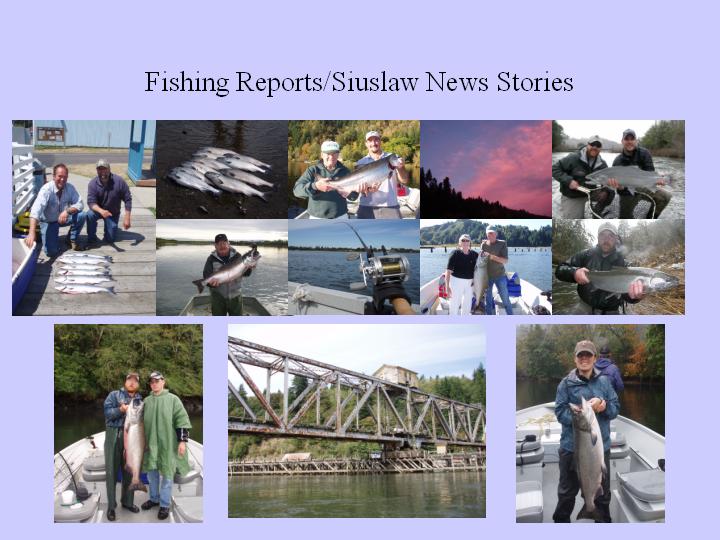
Winter steelhead are starting to show in good numbers on the Oregon Coast. These are just two of the several wild beauties hooked earlier this week. All your favorite techniques will work on these aggressive fish.
Here's this week's Siuslaw News story...
High Water Options for Steelhead and Salmon
We’ve all been there – you work hard all week and wait anxiously for the weekend. It starts raining Thursday night and pours all day Friday. By Saturday morning, your favorite river is 5 feet higher than you like to fish it and the color of café latte. Most fisherfolks would give up, but I say that’s a mistake! You can still catch fish under these conditions. I’ve had some of my best days during high water, when other anglers are still cleaning out the garage, or, even worse, sitting on the couch. There are few things more satisfying than catching fish when others think you’re crazy for even trying.
The “Whys” and “Wheres” of High Water Fishing
Simply put, you fish during high water because its when fish are moving. High water makes it easier for fish to navigate barriers such as falls and rapids. Rain is the cue for salmon and steelhead to move upriver for spawning. You can’t count on being able to find the fish as you would under normal water conditions. Let the fish find you. Also, forget about those favorite runs and drifts where the fish will be when the river drops and clears. Fish moving upstream will choose the path of least resistance, meaning they will be moving right along the bank, often within 10 feet of shore. There are several reasons for this. Salmon and steelhead will choose the path of least resistance. Moving along the bank means the fish are staying out of the main flow, which means they are using less energy. Imagine being faced with either moving slowly through the blackberries or taking a game trail, my guess is you will take the trail! Also, the softer flows available along the shore means less sediment in the water, which makes it easier for the fish to respire. Salmon and steelhead moving along the shore will be especially true in rapids. With high winter flows, the edge of the river might be the only place these fish will be able to move upstream. Concentrate your efforts near or in rapids, and very near the bank. These are the areas through which the fish will move.
Please join me next week as I talk more about high water options for salmon and steelhead.
See you on the water,
Action Jackson
(Please send comments or questions to Action Jackson at 268-6944 or www.actionjacksonfishing.com)
Wednesday, December 19, 2007
Reduce The Limit For Wild Salmon and Steelhead
Fall chinook runs on the Oregon coast this year are very depressed. As I’ve mentioned in previous articles, fish runs in world-famous fisheries such as the Rogue River, Umpqua River and Tillamook Bay are so low that it’s caused alarm bells to go off with the Oregon Dept. of Fish and Wildlife. This fall’s poor run comes on the heels of terrible spring chinook numbers on the Rogue, Umpqua and in the Willamette Valley.
You might say, “Hey, I got my fish out here in the river. I saw a bunch of fish caught. What’s the big deal?” Remember, the fall chinook run on the Siuslaw was one of the strongest on the Oregon Coast, but was still only an estimated 30% of last year’s run. Spawning fish estimates throughout the basin show that this year’s run is very poor. I’ve seen it myself on Knowles Creek: I’ve been walking the entire lower creek which is a traditional chinook stronghold. And very few fish are around. In years past, by this point in the season I would have seen 200-300 fall chinook and dozens of redds. This year it’s been less than 20 chinook and less than 10 redds.
This is bringing me around to the point of my article – that it’s time to reduce the statewide limit for wild salmon and steelhead.
How Many Fish Do You Really Need?
If an angler filled their salmon/steelhead tag exclusively with fall chinook (20 fish) at approximately 25 lbs. each that equates to 400 lbs of fish. If you only got 35% fillet (you’d probably get more), that is 175 lbs. of pure meat. A person could eat a ½ pound of salmon almost every day of the year (350 days). Believe me, experience tells me that nobody is going to do this. I got sick of eating salmon every day after just a couple of months. I don’t care how many different recipes you have. Someone out there is going to say “I have a family to support and I depend on those fish.” Fine. Take your wife and kids fishing with you and you’ll still have enough salmon to stuff the whole gang.
Drop The Limit To 10 Wild Fish Per Season
Ten wild salmon or steelhead per season is more than enough. The remaining 10 spots on the tag could be used for halibut, sturgeon or hatchery fish. And if 10 salmon aren’t enough for you, buy a Hatchery Harvest Tag which allows you to harvest 10 more hatchery salmon and steelhead. The cost is $12 and there’s no limit on the number of tags you can buy.
We as anglers and lovers of the resource owe it to the fish to do everything we can to make sure runs remain strong. This is something easy we can do to help save our fish runs. So many times in the past we’ve over-used a resource until it was too late. We shouldn’t let individual greed and the attitude of “I’ve got to get all that’s coming to me” destroy something we all love.
See you on the water,
Action Jackson
(Please send comments or questions to Action Jackson at 268-6944 or www.actionjacksonfishing.com)
You might say, “Hey, I got my fish out here in the river. I saw a bunch of fish caught. What’s the big deal?” Remember, the fall chinook run on the Siuslaw was one of the strongest on the Oregon Coast, but was still only an estimated 30% of last year’s run. Spawning fish estimates throughout the basin show that this year’s run is very poor. I’ve seen it myself on Knowles Creek: I’ve been walking the entire lower creek which is a traditional chinook stronghold. And very few fish are around. In years past, by this point in the season I would have seen 200-300 fall chinook and dozens of redds. This year it’s been less than 20 chinook and less than 10 redds.
This is bringing me around to the point of my article – that it’s time to reduce the statewide limit for wild salmon and steelhead.
How Many Fish Do You Really Need?
If an angler filled their salmon/steelhead tag exclusively with fall chinook (20 fish) at approximately 25 lbs. each that equates to 400 lbs of fish. If you only got 35% fillet (you’d probably get more), that is 175 lbs. of pure meat. A person could eat a ½ pound of salmon almost every day of the year (350 days). Believe me, experience tells me that nobody is going to do this. I got sick of eating salmon every day after just a couple of months. I don’t care how many different recipes you have. Someone out there is going to say “I have a family to support and I depend on those fish.” Fine. Take your wife and kids fishing with you and you’ll still have enough salmon to stuff the whole gang.
Drop The Limit To 10 Wild Fish Per Season
Ten wild salmon or steelhead per season is more than enough. The remaining 10 spots on the tag could be used for halibut, sturgeon or hatchery fish. And if 10 salmon aren’t enough for you, buy a Hatchery Harvest Tag which allows you to harvest 10 more hatchery salmon and steelhead. The cost is $12 and there’s no limit on the number of tags you can buy.
We as anglers and lovers of the resource owe it to the fish to do everything we can to make sure runs remain strong. This is something easy we can do to help save our fish runs. So many times in the past we’ve over-used a resource until it was too late. We shouldn’t let individual greed and the attitude of “I’ve got to get all that’s coming to me” destroy something we all love.
See you on the water,
Action Jackson
(Please send comments or questions to Action Jackson at 268-6944 or www.actionjacksonfishing.com)
Tuesday, December 11, 2007
2nd Annual What To Get The Angler On Your List for Christmas
With the holiday season just around the corner, its time to think about the angler on your gift list. Last year’s list was geared toward the angler in the family while this year’s list includes some gifts that the whole family can enjoy. These items will add to the experience on the water and help you capture those great times. These are things no fisherman should be without.
Digital Camera. Want to see if that picture of your big bass or trophy trout turned out? Find out instantly with a digital camera. Prices have come down significantly over the past few years on quality cameras. The software is easily downloaded on your computer and you can share photos with family and friends around the world. Olympus, Sony, Canon and several other manufacturers make quality cameras that are very user friendly. Got no one to send a picture to? Send ‘em to me, I love looking at fish pictures.
Binoculars. During my trips on the rivers and coastal lakes this year, my guests and I have seen elk, deer, bear, otters, beavers, weasels, mink, seals, eagles, osprey, hawks and all sorts of waterfowl. A great day on the water can be made even better by having a small pair of binoculars on the boat. Also, they’re handy for checking out other boats and what they’re using for bait. Bushnell Corp. (www.bushnell.com) is a quality American manufacturer that has a great product line.
Inflatable PFD. This item made the list last year, and it made it again this year. A PFD is an absolute necessity on the water. Stearns Sospenders® are lightweight and more comfortable than any other flotation device out there. Plus, they can save your life. What better gift is there? www.stearnsinc.com
Salmon Trolling Rod and Reel. The Berkley® Air® IM-7 rod, rated extra heavy, 15-50 lb. test (www.berkley-fishing.com) teamed with the Abu Garcia® Ambassadeur® C3 model 6500 (www.abugarcia.com) is a great salmon trolling combo. The rods are strong enough to take on the biggest fall chinook, yet sensitive enough to let you know when a fish is just starting to chew on your herring. The reels have large capacity spools and a clicker. This is a great setup for the price.
Bucket Potty Seat. Sometimes you’re a long way from a bathroom and instead of pulling off when the bite is on, just go right in the boat! The Bucket Potty Seat is a 5-gallon bucket with a secure toilet seat that, if you have one on the boat, will let your guests piddle comfortably while you keep the baits in the water. It’s available online through West Marine, www.westmarine.com (type in Model # 597443). Just make sure to put the lid down when you’re finished.
Rain Bibs. Grundens® Hercules® 16 bib pants are a necessity if you’re going to get wet. I pretty much live in mine all fall and winter when I’m in the boat. They’re tough, completely waterproof and will last for years. This is the stuff the professionals use. Try them out and you won’t go back. www.grundens.com.
These are just a few of many ideas that any Oregon angler will use. If you still aren’t sure, give me a call and we can talk about some more gift ideas.
See you on the water,
Action Jackson
(Please send comments or questions to Action Jackson at 268-6944 or www.actionjacksonfishing.com)
Digital Camera. Want to see if that picture of your big bass or trophy trout turned out? Find out instantly with a digital camera. Prices have come down significantly over the past few years on quality cameras. The software is easily downloaded on your computer and you can share photos with family and friends around the world. Olympus, Sony, Canon and several other manufacturers make quality cameras that are very user friendly. Got no one to send a picture to? Send ‘em to me, I love looking at fish pictures.
Binoculars. During my trips on the rivers and coastal lakes this year, my guests and I have seen elk, deer, bear, otters, beavers, weasels, mink, seals, eagles, osprey, hawks and all sorts of waterfowl. A great day on the water can be made even better by having a small pair of binoculars on the boat. Also, they’re handy for checking out other boats and what they’re using for bait. Bushnell Corp. (www.bushnell.com) is a quality American manufacturer that has a great product line.
Inflatable PFD. This item made the list last year, and it made it again this year. A PFD is an absolute necessity on the water. Stearns Sospenders® are lightweight and more comfortable than any other flotation device out there. Plus, they can save your life. What better gift is there? www.stearnsinc.com
Salmon Trolling Rod and Reel. The Berkley® Air® IM-7 rod, rated extra heavy, 15-50 lb. test (www.berkley-fishing.com) teamed with the Abu Garcia® Ambassadeur® C3 model 6500 (www.abugarcia.com) is a great salmon trolling combo. The rods are strong enough to take on the biggest fall chinook, yet sensitive enough to let you know when a fish is just starting to chew on your herring. The reels have large capacity spools and a clicker. This is a great setup for the price.
Bucket Potty Seat. Sometimes you’re a long way from a bathroom and instead of pulling off when the bite is on, just go right in the boat! The Bucket Potty Seat is a 5-gallon bucket with a secure toilet seat that, if you have one on the boat, will let your guests piddle comfortably while you keep the baits in the water. It’s available online through West Marine, www.westmarine.com (type in Model # 597443). Just make sure to put the lid down when you’re finished.
Rain Bibs. Grundens® Hercules® 16 bib pants are a necessity if you’re going to get wet. I pretty much live in mine all fall and winter when I’m in the boat. They’re tough, completely waterproof and will last for years. This is the stuff the professionals use. Try them out and you won’t go back. www.grundens.com.
These are just a few of many ideas that any Oregon angler will use. If you still aren’t sure, give me a call and we can talk about some more gift ideas.
See you on the water,
Action Jackson
(Please send comments or questions to Action Jackson at 268-6944 or www.actionjacksonfishing.com)
Sunday, November 18, 2007
High Winds Make Fishing Tough

Hello Anglers,
Weather conditions over the past few days have made silver fishing on the lakes difficult. High winds made fly fishing impossible, and it was tough trolling too. We've had close to 5 inches of rain since Thu the 15th, which means once conditions allow, the lakes should be full of silvers.
Phil Gilman came up from California and fished with me for 3 days. We fly fished for silvers, with limited results. We only managed trout in tough conditions. Switching over to spinners, we had better success. We hooked several fish, landed jacks and trout, and landed a nice silver.
Here's this week's Siuslaw News story...
Trolling for Coho Salmon In the Lakes
Within the next few weeks, Coho salmon will start moving into Siltcoos and Tahkenitch Lakes in greater numbers. We here on the central coast are fortunate enough to have the only wild Coho fishery in Oregon. These fish are aggressive and easier to catch than their larger cousins (Chinook).
Why Trolling?
Trolling is the best way to cover water and increase your chances of finding aggressive fish. You constantly have your offering in the water and at the level where fish will find it. Trolling also puts your presentation down to the right depth quickly and efficiently.
Rods, Reels and Line
When trolling, consider using a medium action rod/reel combination spooled with 15 lb. test line. A medium action rod allows for good plug action and makes for a fun fight once a salmon is hooked. I use a 7 ft. rod so I can net the fish easily by myself. If you use a longer rod, it makes netting difficult. Levelwind or baitcasting reels are made for trolling. Attach a barrel swivel to the main line and attach 4 feet of lighter leader (10 or 12 lb. test). Again, lighter line (and tackle) allows for greater plug movement.
What Plugs To Use
While many different plugs and spinners work, I use Wiggle Warts™, Hot Shots™ and Brad’s Wigglers™ more than any other. I have a selection of colors including pink, orange, blue/silver, green/silver and silver. I recommend changing colors often to find the plug the fish are taking. In order to change plugs without re-tying, tie a locking snap or snap swivel on the end of your leader.
Where To Look for Fish
The first thing to do is look at a map of the lake you’ll be fishing. Notice the “arms” or coves of the lake into which tributaries drain. That’s where the salmon will eventually end up – they’re going to head up those tributaries to spawn. The salmon will mill around in these arms until enough rain falls to raise stream levels. On one lake, look for names such as Fiddle and Maple, and on another lake look for names like Five Mile and Leitel. These names will point you in the right direction.
Final Thoughts
Take a buddy or two fishing with you. You can run different plugs and find what the fish want. Another great location to find fish is in the lake adjacent to the outlet. All fish heading into the lake will be moving right past you (at some point). Try letting out 40-60’ of line when trolling. This will maximize the depth at which the plug will dive and keep you out of the weeds.
See you on the water,
Action Jackson
(Please send comments or questions to Action Jackson at 268-6944 or www.actionjacksonfishing.com)
Sunday, November 11, 2007
Rain Will Help Silver Fishing
Hello Anglers!
This week's rain should help the silver fishing in the lakes. I'll be out several times next week fishing for silvers with fly gear. I'll post updates later this week.
Here's this week's Siuslaw News story...
Snaggers Steal From All Of Us
The rains a couple of weeks ago moved many chinook up river. For a while, great fishing was had in many of the deeper holes and slots from Deadwood all the way down Lake Creek and on the mainstem Siuslaw. Now that the river has dropped down to pre-rain flows, opportunities for snagging salmon are all over the place. Salmon may be trapped in some holes by low water making them an easy target. Let’s talk a little bit about why this is so sickening.
Snagging For Eggs
Many snaggers are not after the salmon to feed their families, since many fish easily seen are marginal at best. They’re after big female fish with eggs. They’ll cut the fish open, take the eggs, and throw away the rest of the fish in some location where it’s unlikely to be found. Pretty disgusting. Snaggers often target fish on their spawning beds, where they will sit for long periods and, when disturbed, will return to the same spot. Maybe the saddest part about this whole thing is that the eggs aren’t high quality, either. Eggs in dark fish are often loose (single eggs) since the skein diminishes before the female salmon deposits them in the nest. So just like that, a snagger taking a fish off the spawning gravel has literally destroyed thousands of eggs.
Time To Close Upper Siuslaw and Lake Creek?
It may be time that ODFW consider closing portions of Lake Creek and the Siuslaw until later in the season. I realize that many salmon fishermen without a boat depend on fishing these areas, and that fresh salmon can be caught there, even in low water. But snagging is a problem that needs to be addressed. If the Siuslaw was closed from the confluence of Lake Creek upstream until November 1, there would still be plenty of good locations folks could reach from the bank.
What You Can Do
First of all, keep your eyes open when you’re out on the water. There’s the old saying that “if you think something’s wrong, it probably is.” If fishermen seem nervous and not very talkative, something may be wrong. Most folks out on the water will gladly tell you what’s going on, how they did, what they saw, etc. If you have a cell phone on you, call the Oregon Poacher’s Hotline at 800-452-7888. Get a description of the vehicle, suspects, and any other relevant information. Remember, you are protecting your fish, your children’s fish and your grandchildren’s fish. Do your part to help the fish you love.
See you on the water,
Action Jackson
(Please send comments or questions to Action Jackson at 268-6944 or www.actionjacksonfishing.com)
This week's rain should help the silver fishing in the lakes. I'll be out several times next week fishing for silvers with fly gear. I'll post updates later this week.
Here's this week's Siuslaw News story...
Snaggers Steal From All Of Us
The rains a couple of weeks ago moved many chinook up river. For a while, great fishing was had in many of the deeper holes and slots from Deadwood all the way down Lake Creek and on the mainstem Siuslaw. Now that the river has dropped down to pre-rain flows, opportunities for snagging salmon are all over the place. Salmon may be trapped in some holes by low water making them an easy target. Let’s talk a little bit about why this is so sickening.
Snagging For Eggs
Many snaggers are not after the salmon to feed their families, since many fish easily seen are marginal at best. They’re after big female fish with eggs. They’ll cut the fish open, take the eggs, and throw away the rest of the fish in some location where it’s unlikely to be found. Pretty disgusting. Snaggers often target fish on their spawning beds, where they will sit for long periods and, when disturbed, will return to the same spot. Maybe the saddest part about this whole thing is that the eggs aren’t high quality, either. Eggs in dark fish are often loose (single eggs) since the skein diminishes before the female salmon deposits them in the nest. So just like that, a snagger taking a fish off the spawning gravel has literally destroyed thousands of eggs.
Time To Close Upper Siuslaw and Lake Creek?
It may be time that ODFW consider closing portions of Lake Creek and the Siuslaw until later in the season. I realize that many salmon fishermen without a boat depend on fishing these areas, and that fresh salmon can be caught there, even in low water. But snagging is a problem that needs to be addressed. If the Siuslaw was closed from the confluence of Lake Creek upstream until November 1, there would still be plenty of good locations folks could reach from the bank.
What You Can Do
First of all, keep your eyes open when you’re out on the water. There’s the old saying that “if you think something’s wrong, it probably is.” If fishermen seem nervous and not very talkative, something may be wrong. Most folks out on the water will gladly tell you what’s going on, how they did, what they saw, etc. If you have a cell phone on you, call the Oregon Poacher’s Hotline at 800-452-7888. Get a description of the vehicle, suspects, and any other relevant information. Remember, you are protecting your fish, your children’s fish and your grandchildren’s fish. Do your part to help the fish you love.
See you on the water,
Action Jackson
(Please send comments or questions to Action Jackson at 268-6944 or www.actionjacksonfishing.com)
Friday, November 2, 2007
Silvers Have Arrived!

Hello Anglers,
Silvers are starting to show in the coastal lakes. No rain was needed as a series of high tides at the end of Oct and first part of Nov moved some fish in. These fish are bright and very aggressive. We know they're bright because they answered 4 out of 5 questions correctly! On a serious note, fishing should be good the whole month of Nov and into Dec. Central Coast silvers are late spawners (Dec and Jan) so fresh fish will continue to enter the lakes. If fly fishing is your game, this is your best chance of the year to land a salmon on a fly rod south of Alaska. I have openings in Nov and Dec so come on down.
Here's this week's Siuslaw News story...
News From Around The Area
Nice weather and high pressure built back in to our area over the last several days, which usually means chinook stop in upper tidewater before heading upriver. This hasn’t been the case. Catches of chinook in tidewater have been poor. It seems most chinook are still just moving straight through to points upstream. Fresh chinook are still in the system, but you need to pursue them upriver. Try deeper holes and slots between Mapleton and Swisshome using bobber/eggs. Be prepared to get on the water early as the best spots are taken before daylight. Another option is fishing the same spots late in the afternoon, after the crowds have left. Salmon move from dusk until dawn, and moving fish are aggressive fish (more easily caught). Fish can be caught late in the day.
A Note To Lane County
Recently Lane County began charging a launch fee at local boat ramps, including the ramp in Mapleton. The cost is $3 per day or $30 per year (expires in Dec.). It doesn’t seem like the money collected is going toward maintaining the ramp. At lower stages of the tide, the launch is unusable. The end of the ramp is heavily silted in, and hasn’t been cleaned out for several seasons. Three dollars is a lot of money if you have to wait a few hours for the tide to come in to put your boat in the water. Especially when the fish are biting. So, Lane County, if you’re going to charge, maintain the areas for which you’re charging.
See you on the water,
Action Jackson
(Please send comments or questions to Action Jackson at 268-6944 or www.actionjacksonfishing.com)
Nice weather and high pressure built back in to our area over the last several days, which usually means chinook stop in upper tidewater before heading upriver. This hasn’t been the case. Catches of chinook in tidewater have been poor. It seems most chinook are still just moving straight through to points upstream. Fresh chinook are still in the system, but you need to pursue them upriver. Try deeper holes and slots between Mapleton and Swisshome using bobber/eggs. Be prepared to get on the water early as the best spots are taken before daylight. Another option is fishing the same spots late in the afternoon, after the crowds have left. Salmon move from dusk until dawn, and moving fish are aggressive fish (more easily caught). Fish can be caught late in the day.
A Note To Lane County
Recently Lane County began charging a launch fee at local boat ramps, including the ramp in Mapleton. The cost is $3 per day or $30 per year (expires in Dec.). It doesn’t seem like the money collected is going toward maintaining the ramp. At lower stages of the tide, the launch is unusable. The end of the ramp is heavily silted in, and hasn’t been cleaned out for several seasons. Three dollars is a lot of money if you have to wait a few hours for the tide to come in to put your boat in the water. Especially when the fish are biting. So, Lane County, if you’re going to charge, maintain the areas for which you’re charging.
See you on the water,
Action Jackson
(Please send comments or questions to Action Jackson at 268-6944 or www.actionjacksonfishing.com)
Subscribe to:
Comments (Atom)