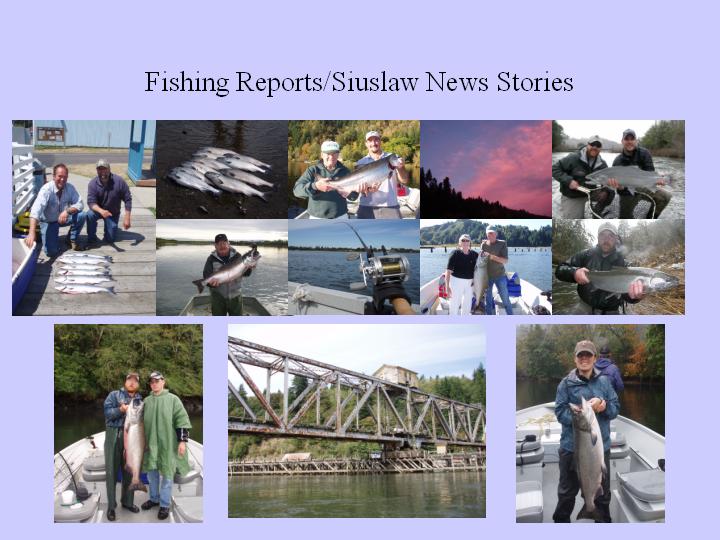
Fall is just around the corner and the fish can feel it. Things are picking up and good fishing is just around the corner. Last week’s rain (over 2 inches in Mapleton) will cool the water down and draw fish in. Here’s what I’ve seen the last few days and what others are reporting:
Fish Are In On The Umpqua
A good bite has been happening on the Umpqua recently. Fish down toward Winchester Bay for a chance at both clipped Silvers and Chinook. Last week fish were caught up to Reedsport and above. Herring are the bait of choice and most anglers are running them with flashers. My experience is that there doesn’t seem to be as much debris in the water on the Umpqua, making it easier to run flashers. As with the Siuslaw, most boats move with the tide, making it easier to keep your presentation on the bottom and in the strike zone. Over the weekend there were quite a few boats, so fish the weekdays for less traffic.
Crabbing Picking Up
Crabbing is starting to get a lot better during the last couple of weeks. All your favorite crabbing bays (Alsea, Siuslaw, Winchester) are producing good catches. Best crabbing will be found during the incoming tide, close to the mouth. Recent rains should not slow down catches as there’s not enough fresh water to push crabs out. Many different baits will produce, including shad, tuna heads, chicken or turkey, salmon carcasses, etc.
Not Too Early For The Siuslaw
Though more fish are present down south on the Umpqua, a few fish are starting to show on the Siuslaw. Fishing will get better as the water cools. Some fish have been checked in for little effort.
Know Your Closed Area
Last Friday I ran into some very nice guys from the U.S. Coast Guard, Siuslaw River Station. They informed me that when the Rough Bay Warning Lights are on and the bar is closed, the area downriver from Marker #4 is restricted. If you have any questions, you can call the U.S. Coast Guard recorded message at (541) 902-7792. Next, you can tune your AM/FM radio to 1610 AM. You can also hail the Coast Guard directly on your VHF radio channel 16.
See you on the water,
Action Jackson
(Please send comments or questions to Action Jackson at 268-6944 or www.actionjacksonfishing.com)
Thursday, August 28, 2008

Wednesday, August 20, 2008
Brining Herring
Hello Readers! I’ve recently been getting some questions on preparing herring for trolling. Here’s an quick and effective brine I like to use. Remember to experiment with different scents as it is a key to success. No single scent is the most effective every day.
Herring is probably the #1 bait for Fall Chinook salmon. If you talked to 100 salmon anglers, you’re likely to get that many different brines for herring! There are numerous scents and secret recipes that fishermen have, too many to go into here. Start with a basic recipe, and experiment. What’s that? You say you have the surefire, can’t miss formula? Shoot me an e-mail and I’ll try it out!
The Basic Recipe
This recipe will brine 4-6 dozen herring. Don’t need that many, cut back the ingredients equally to fit the amount of bait you want to brine. To eliminate unwanted scents, use latex gloves to put together the brine.
2 ½ gallons distilled water. You can use tap water, but let the water sit overnight. This allows chlorine to evaporate. Scent is very important. You want to make sure the herring only absorb the scents you want them to absorb.
3 tablespoons of Mrs. Stewart’s liquid bluing. This makes the herring’s scales really shine. Mrs. Stewart’s is not particularly easy to find, so don’t start asking around the night you need it. Randy’s Riverview Market in Mapleton stocks it, and local grocers can order it.
4 cups rock salt, canning salt, or non-iodized salt.
1 cup powdered milk. Powdered milk firms the herring without burning it.
Scent of your choosing. Popular scents include garlic oil (from a jar of minced garlic) or 2 tablespoons of pure anise oil.
Mix all ingredients together, making sure to allow time for the salt to dissolve.
Now, For the Herring…
Most herring purchased these days are “shrink wrapped” to preserve them and minimize freezer burn. Partially thaw the herring before you brine them. Make sure to poke holes in the package as you allow them to thaw. If you don’t, the plastic wrapping will pull scales off these delicate fish during the thawing process.
Letting Them Brine
You’ll want the herring to brine at least overnight. If possible, store them in a cool spot or refrigerate the herring while they brine. After brining, they can be refrozen. Frozen herring cut much better than soft herring, and you’ll lose fewer scales. If you’re fishing all day, put some herring in a small cooler that you’ll be opening a lot, and place others in another cooler that stays shut, keeping the bait frozen until you’re ready to use them.
Drop me a line and let me know what you think about these or other topics.
See you on the water,
Action Jackson
(Please send comments or questions to Action Jackson at 268-6944 or www.actionjacksonfishing.com)
Herring is probably the #1 bait for Fall Chinook salmon. If you talked to 100 salmon anglers, you’re likely to get that many different brines for herring! There are numerous scents and secret recipes that fishermen have, too many to go into here. Start with a basic recipe, and experiment. What’s that? You say you have the surefire, can’t miss formula? Shoot me an e-mail and I’ll try it out!
The Basic Recipe
This recipe will brine 4-6 dozen herring. Don’t need that many, cut back the ingredients equally to fit the amount of bait you want to brine. To eliminate unwanted scents, use latex gloves to put together the brine.
2 ½ gallons distilled water. You can use tap water, but let the water sit overnight. This allows chlorine to evaporate. Scent is very important. You want to make sure the herring only absorb the scents you want them to absorb.
3 tablespoons of Mrs. Stewart’s liquid bluing. This makes the herring’s scales really shine. Mrs. Stewart’s is not particularly easy to find, so don’t start asking around the night you need it. Randy’s Riverview Market in Mapleton stocks it, and local grocers can order it.
4 cups rock salt, canning salt, or non-iodized salt.
1 cup powdered milk. Powdered milk firms the herring without burning it.
Scent of your choosing. Popular scents include garlic oil (from a jar of minced garlic) or 2 tablespoons of pure anise oil.
Mix all ingredients together, making sure to allow time for the salt to dissolve.
Now, For the Herring…
Most herring purchased these days are “shrink wrapped” to preserve them and minimize freezer burn. Partially thaw the herring before you brine them. Make sure to poke holes in the package as you allow them to thaw. If you don’t, the plastic wrapping will pull scales off these delicate fish during the thawing process.
Letting Them Brine
You’ll want the herring to brine at least overnight. If possible, store them in a cool spot or refrigerate the herring while they brine. After brining, they can be refrozen. Frozen herring cut much better than soft herring, and you’ll lose fewer scales. If you’re fishing all day, put some herring in a small cooler that you’ll be opening a lot, and place others in another cooler that stays shut, keeping the bait frozen until you’re ready to use them.
Drop me a line and let me know what you think about these or other topics.
See you on the water,
Action Jackson
(Please send comments or questions to Action Jackson at 268-6944 or www.actionjacksonfishing.com)
Tie Your Own Spinner Rigs For Blueback
If you’re looking for some fishing in the river until good numbers of Chinook show, look no further than Searun cutthroat trout, or Blueback. Right now there are plenty around, they’re aggressive and great to eat. Local fish expert Lynn Hood tells me folks are doing very well in the vicinity of C&D Dock, but fish are available from Mapleton down (and probably above if you know where to look).
Spinners Are Popular
Running into Hood at The Riverview Market was inspirational. He was tying up a spinner for Blueback that looked very simple and effective. It reminded me of the anchovy spinners used at the mouth of the Rogue River for Fall Chinook. The big differences are that you don’t need a treble hook, and you don’t need heavy leader. Here’s what you’ll need to get started:
10-12 lb. leader. I thought about this one a lot. Some guys would say that this is too heavy for Blueback. It’s true – it is more than you need. But here’s why I say use it – if something much larger grabs your spinner, you want to have at least a fighting chance of landing it.
An assortment of 4-6 mm beads. Look for different colors such as orange, green, blue, chartreuse, yellow and red. Get some beads in each 4, 5 and 6 mm if you can find them. If you need help finding bead sources give me a call and I can point you in the right direction.
Plastic clevises. A lot of folks use wire or metal clevises and that’s fine. Let me tell you why I use the plastic – because you can change spinner blades quickly. Simply snap one off and put on another. And rarely do you lose a blade (unless you lose the whole spinner).
An assortment of #3 and #4 Colorado spinner blades. Try some of these popular colors: silver, brass, copper, and some painted blades (green, fluorescent orange, blue, etc.). There are many different finishes available. Again – if you need some help – I can tell you where to get started.
Baitholder hooks. These hooks have a long, straight shank that has barbs to help hold a nightcrawler on the hook. Experiment with different sizes to get what you like, but I often use something between a #1 and #4. Gamakatsu makes a very good Baitholder hook that’s sticky sharp out of the package and stays that way.
Very Simple, Very Easy
On approximately 36” of leader, tie on the hook, add 3 of the large beads, 3 of the medium beads, and 2 of the small beads. Add the clevis. Add the blade to the clevis. It doesn’t get any easier. On the river, add ½ nightcrawler and troll your spinner behind a Ford Fender™ or Cow Bell™. Don’t forget to use a small trolling rudder to keep your rig from twisting up.
The Blueback are in, so if you’re not catching switch colors, blades and location until you find the formula that works.
See you on the water,
Action Jackson
(Please send comments or questions to Action Jackson at 268-6944 or www.actionjacksonfishing.com)
Spinners Are Popular
Running into Hood at The Riverview Market was inspirational. He was tying up a spinner for Blueback that looked very simple and effective. It reminded me of the anchovy spinners used at the mouth of the Rogue River for Fall Chinook. The big differences are that you don’t need a treble hook, and you don’t need heavy leader. Here’s what you’ll need to get started:
10-12 lb. leader. I thought about this one a lot. Some guys would say that this is too heavy for Blueback. It’s true – it is more than you need. But here’s why I say use it – if something much larger grabs your spinner, you want to have at least a fighting chance of landing it.
An assortment of 4-6 mm beads. Look for different colors such as orange, green, blue, chartreuse, yellow and red. Get some beads in each 4, 5 and 6 mm if you can find them. If you need help finding bead sources give me a call and I can point you in the right direction.
Plastic clevises. A lot of folks use wire or metal clevises and that’s fine. Let me tell you why I use the plastic – because you can change spinner blades quickly. Simply snap one off and put on another. And rarely do you lose a blade (unless you lose the whole spinner).
An assortment of #3 and #4 Colorado spinner blades. Try some of these popular colors: silver, brass, copper, and some painted blades (green, fluorescent orange, blue, etc.). There are many different finishes available. Again – if you need some help – I can tell you where to get started.
Baitholder hooks. These hooks have a long, straight shank that has barbs to help hold a nightcrawler on the hook. Experiment with different sizes to get what you like, but I often use something between a #1 and #4. Gamakatsu makes a very good Baitholder hook that’s sticky sharp out of the package and stays that way.
Very Simple, Very Easy
On approximately 36” of leader, tie on the hook, add 3 of the large beads, 3 of the medium beads, and 2 of the small beads. Add the clevis. Add the blade to the clevis. It doesn’t get any easier. On the river, add ½ nightcrawler and troll your spinner behind a Ford Fender™ or Cow Bell™. Don’t forget to use a small trolling rudder to keep your rig from twisting up.
The Blueback are in, so if you’re not catching switch colors, blades and location until you find the formula that works.
See you on the water,
Action Jackson
(Please send comments or questions to Action Jackson at 268-6944 or www.actionjacksonfishing.com)
Thursday, July 24, 2008
Back From Alaska


Hello Readers!
Just got back from guiding in Alaska for the last 5 weeks for Larry Lund at Togiak River Lodge. Fishing this year for kings wasn't as good as some years, but we still caught many fish. We had several 30+ fish days for kings up to 40 lbs. The weather wasn't nice with high winds, rain and cold on several days. But when Alaska is nice, its one of the most beautiful places on earth. If you're considering a trip to Alaska, you can't go wrong with Togiak River Lodge. The fishing, the food and service is top-notch.
So You Want To Be A Fishing Guide In Alaska
Many young men come north every summer with stars in their eyes. They dream of 100 fish days, endless daylight and having all the comforts of home. While its true fishing can be incredible, most who come here aren’t prepared for the hard work for hours and days on end.
Opening Camp
I was fortunate enough to have commitments at home that kept me from most of the most strenuous days. Usually there are a variety of building projects: maybe a new deck, window installations, or walkway construction. Last year the lodge I work for built two new cabins in ten days. We hauled gravel, 5-gallons at a time, from downriver to cover up soft spots around buildings and paths. Every boat and motor must be gone through to make sure it won’t fail at the wrong time. Boats are cleaned and re-carpeted. Tons of materials are brought in and put away. Everything from tools and paint to food and toilet paper are stowed. Trash is either burned or hauled downriver to the dump. The main lodge and guest rooms are cleaned. Tackle is sorted and distributed. And then there’s the constant upkeep of all machines, water and sewage pumps, motors and other equipment. Hopefully you can find the right tool or part you need as you can’t just run down to Ace Hardware. If you need it right now, expect it at least a week after you order it. Oh, and expect it to be twice as much as you’re used to paying.
Washing Out
I came over to Togiak Village with a young guy who was hired to help around camp and guide later in the year for Silvers. He was worried about how much he’d get to guide since there seemed to be so many guys ahead of him. I told him it was likely that not every guide would make it through the season. And it didn’t take long. Through his own weakness and immaturity, one of the guides ended up quitting and going home. He had the dream of fishing 7 days a week and catching tons of fish every day. What he didn’t realize is that guiding isn’t about catching fish. Guiding is about responsibility, safety and being a team player. His ego prevented him from accepting advice and moving on, and $800 to change his plane ticket didn’t stop him either.
The guide who washed out wasn’t the only one to leave camp so far. One of the young guys hired to help out around camp had personality conflicts with the chefs. Throwing 18 people together who don’t know each other is bound to cause conflicts. Every person is just not going to get along with everyone else. This is where maturity and inter-personal skills come into play.
Bugs and Weather
So far, the weather here has been cold and rainy. The sun pops out every now and then, but soon disappears. Its nice in a way because it keeps the bugs down. When the wind dies and the sun does come out, billions of biting insects are ready to suck the life out of every living mammal around. Mosquitos, No See Ums and White Socks (a small biting gnat) will find you no matter where you are.
There’s plenty to fall in love with here and the rewards too many to mention. The quiet and beauty of the bush make up for the hardships. The personal lessons learned from sticking it out will last a lifetime. The volume of fish in the rivers is incredible. But it takes someone with character to make the most of the experience.
See You On The Water,
Action Jackson
Opening Camp
I was fortunate enough to have commitments at home that kept me from most of the most strenuous days. Usually there are a variety of building projects: maybe a new deck, window installations, or walkway construction. Last year the lodge I work for built two new cabins in ten days. We hauled gravel, 5-gallons at a time, from downriver to cover up soft spots around buildings and paths. Every boat and motor must be gone through to make sure it won’t fail at the wrong time. Boats are cleaned and re-carpeted. Tons of materials are brought in and put away. Everything from tools and paint to food and toilet paper are stowed. Trash is either burned or hauled downriver to the dump. The main lodge and guest rooms are cleaned. Tackle is sorted and distributed. And then there’s the constant upkeep of all machines, water and sewage pumps, motors and other equipment. Hopefully you can find the right tool or part you need as you can’t just run down to Ace Hardware. If you need it right now, expect it at least a week after you order it. Oh, and expect it to be twice as much as you’re used to paying.
Washing Out
I came over to Togiak Village with a young guy who was hired to help around camp and guide later in the year for Silvers. He was worried about how much he’d get to guide since there seemed to be so many guys ahead of him. I told him it was likely that not every guide would make it through the season. And it didn’t take long. Through his own weakness and immaturity, one of the guides ended up quitting and going home. He had the dream of fishing 7 days a week and catching tons of fish every day. What he didn’t realize is that guiding isn’t about catching fish. Guiding is about responsibility, safety and being a team player. His ego prevented him from accepting advice and moving on, and $800 to change his plane ticket didn’t stop him either.
The guide who washed out wasn’t the only one to leave camp so far. One of the young guys hired to help out around camp had personality conflicts with the chefs. Throwing 18 people together who don’t know each other is bound to cause conflicts. Every person is just not going to get along with everyone else. This is where maturity and inter-personal skills come into play.
Bugs and Weather
So far, the weather here has been cold and rainy. The sun pops out every now and then, but soon disappears. Its nice in a way because it keeps the bugs down. When the wind dies and the sun does come out, billions of biting insects are ready to suck the life out of every living mammal around. Mosquitos, No See Ums and White Socks (a small biting gnat) will find you no matter where you are.
There’s plenty to fall in love with here and the rewards too many to mention. The quiet and beauty of the bush make up for the hardships. The personal lessons learned from sticking it out will last a lifetime. The volume of fish in the rivers is incredible. But it takes someone with character to make the most of the experience.
See You On The Water,
Action Jackson
Thursday, June 12, 2008
Regulations for 2008 Fall Chinook Season Still Up In The Air
Late last week the Fish and Wildlife Commission met to rule on emergency regulations for the 2008 Fall Chinook fishery for coastal rivers. Based on public input, expected chinook returns and the best available data, ODFW staff recommended allowing the harvest of 1 fish per day, 5 per season for the 2008 season. While this sounds like a huge hit for recreational fisherman, at least we are able to fish in the river this year. Considering commercial fisherman won’t be allowed to fish for salmon in the ocean and no coastal river in Oregon is expected to meet its minimum escapement, I feel fortunate to be able to fish.
As of Tuesday morning, the Fish and Wildlife Commission hasn’t officially adopted the 1/5 rule for this fall. The ODFW website says that regulations will be finalized over the next few weeks and will take effect on Aug. 1. Here’s the link to the very brief press release http://www.dfw.state.or.us/news/2008/june/060608.asp.
Fishing and Hunting Licenses Going Up Again
In 2010, fishing and hunting licenses are set to increase again. There are three options that have been put forth. Here are the links so you can check out the increases for yourself.
http://www.trustplannow.com/sites/default/files/PackageB.pdf
http://www.trustplannow.com/sites/default/files/PackageC.pdf
http://www.trustplannow.com/sites/default/files/PackageD.pdf
An interesting new item has been added – a “2 Pole License” that would allow an angler to add a 2nd rod for an additional annual fee. The 2 Pole License couldn’t be used when salmon, steelhead or sturgeon fishing. Package “D” has the biggest increases and would actually allow for some money to be re-invested into fish and wildlife projects. Package A, which involves commercial license increases is not listed here.
North To Alaska! (For A Few Weeks)
I’ll be heading to Alaska for a few weeks this summer, guiding at Togiak River Lodge (http://www.togiaklodge.com/) for the Chinook and Rainbow Trout. In the meantime, I’ll be taking a short break from my weekly articles to concentrate on fishing up north. Look for a few updates on the fishing this summer.
See you on the water,
Action Jackson
(Please send comments or questions to Action Jackson at 268-6944 or www.actionjacksonfishing.com)
As of Tuesday morning, the Fish and Wildlife Commission hasn’t officially adopted the 1/5 rule for this fall. The ODFW website says that regulations will be finalized over the next few weeks and will take effect on Aug. 1. Here’s the link to the very brief press release http://www.dfw.state.or.us/news/2008/june/060608.asp.
Fishing and Hunting Licenses Going Up Again
In 2010, fishing and hunting licenses are set to increase again. There are three options that have been put forth. Here are the links so you can check out the increases for yourself.
http://www.trustplannow.com/sites/default/files/PackageB.pdf
http://www.trustplannow.com/sites/default/files/PackageC.pdf
http://www.trustplannow.com/sites/default/files/PackageD.pdf
An interesting new item has been added – a “2 Pole License” that would allow an angler to add a 2nd rod for an additional annual fee. The 2 Pole License couldn’t be used when salmon, steelhead or sturgeon fishing. Package “D” has the biggest increases and would actually allow for some money to be re-invested into fish and wildlife projects. Package A, which involves commercial license increases is not listed here.
North To Alaska! (For A Few Weeks)
I’ll be heading to Alaska for a few weeks this summer, guiding at Togiak River Lodge (http://www.togiaklodge.com/) for the Chinook and Rainbow Trout. In the meantime, I’ll be taking a short break from my weekly articles to concentrate on fishing up north. Look for a few updates on the fishing this summer.
See you on the water,
Action Jackson
(Please send comments or questions to Action Jackson at 268-6944 or www.actionjacksonfishing.com)
Friday, June 6, 2008
Run Timing – Then And Now
A few weeks ago, a fellow angler and I were talking about how the salmon and steelhead weren’t showing up the same time of year they used to. This friend told me, “You know, the steelhead fishing was really good around Thanksgiving, and the run was over by January.” That got me to thinking about when fish should be showing up. Were the runs years ago healthier than today?
When Do Fish Come Back?
Anadromous (sea run) fish return to their home river anywhere from months before they spawn to hours before they spawn. For instance, on the Columbia River, steelhead bound for rivers in Idaho (Columbia River tributaries) enter freshwater many months before they actually spawn. And on Oregon coastal rivers, salmon and steelhead may spawn just hours after entering freshwater. In other words, the length of the journey to spawning grounds dictates (in part) when fish enter a river. Anadromous fish, particularly fall chinook salmon, may also hold in lower stretches of coastal rivers until water levels raise enough to allow them to access suitable spawning gravel. An example of this is as follows: a fall fish may enter the river in September and slowly work its way upriver, and when freshets raise the water level in early November, the fish enters a tributary and spawns during the middle of November.
Run Timing – An Inexact Science
While it’s tough to predict when the “peak” of the run will be, research on salmonids gives us some clues as to when most of the fish will be in the river. On Oregon coastal rivers, run distribution is on a Bell Curve. When examining fall chinook salmon, this means that some fish will be present in the bay and river during July, and some fish will be present in January, but the peak of the run will be present some time during October or November. We make this assumption based on sport catch and results of spawning fish surveys. When we take a look at winter steelhead, the timing is different. Most of these fish spawn in the spring (March and April). And while some steelhead are in the rivers in November and some fish are in the river in May, the peak of the run will probably be in January and February. A Thankgiving peak run just doesn’t sound quite right to me, at least not on the Oregon coast.
What Affects Run Timing?
It’s not that my friend was wrong. I’m sure he had the dates right. But there are many things that can impact run timing of salmon and steelhead. Probably the biggest single impact on run timing in the past was poor hatchery practices. And this is how it works: the eggs of fish used by the hatchery were taken from the first fish that made it to the weir. So, over a few generations the hatchery, by just taking these early fish, inadvertently selected for early arriving fish. Today, hatchery practices are changing. Those in charge realize that fish should be selected throughout the run to ensure that fish come back during the entire time they would naturally.
See you on the water,
Action Jackson
(Please send comments or questions to Action Jackson at 268-6944 or www.actionjacksonfishing.com)
When Do Fish Come Back?
Anadromous (sea run) fish return to their home river anywhere from months before they spawn to hours before they spawn. For instance, on the Columbia River, steelhead bound for rivers in Idaho (Columbia River tributaries) enter freshwater many months before they actually spawn. And on Oregon coastal rivers, salmon and steelhead may spawn just hours after entering freshwater. In other words, the length of the journey to spawning grounds dictates (in part) when fish enter a river. Anadromous fish, particularly fall chinook salmon, may also hold in lower stretches of coastal rivers until water levels raise enough to allow them to access suitable spawning gravel. An example of this is as follows: a fall fish may enter the river in September and slowly work its way upriver, and when freshets raise the water level in early November, the fish enters a tributary and spawns during the middle of November.
Run Timing – An Inexact Science
While it’s tough to predict when the “peak” of the run will be, research on salmonids gives us some clues as to when most of the fish will be in the river. On Oregon coastal rivers, run distribution is on a Bell Curve. When examining fall chinook salmon, this means that some fish will be present in the bay and river during July, and some fish will be present in January, but the peak of the run will be present some time during October or November. We make this assumption based on sport catch and results of spawning fish surveys. When we take a look at winter steelhead, the timing is different. Most of these fish spawn in the spring (March and April). And while some steelhead are in the rivers in November and some fish are in the river in May, the peak of the run will probably be in January and February. A Thankgiving peak run just doesn’t sound quite right to me, at least not on the Oregon coast.
What Affects Run Timing?
It’s not that my friend was wrong. I’m sure he had the dates right. But there are many things that can impact run timing of salmon and steelhead. Probably the biggest single impact on run timing in the past was poor hatchery practices. And this is how it works: the eggs of fish used by the hatchery were taken from the first fish that made it to the weir. So, over a few generations the hatchery, by just taking these early fish, inadvertently selected for early arriving fish. Today, hatchery practices are changing. Those in charge realize that fish should be selected throughout the run to ensure that fish come back during the entire time they would naturally.
See you on the water,
Action Jackson
(Please send comments or questions to Action Jackson at 268-6944 or www.actionjacksonfishing.com)
Subscribe to:
Posts (Atom)