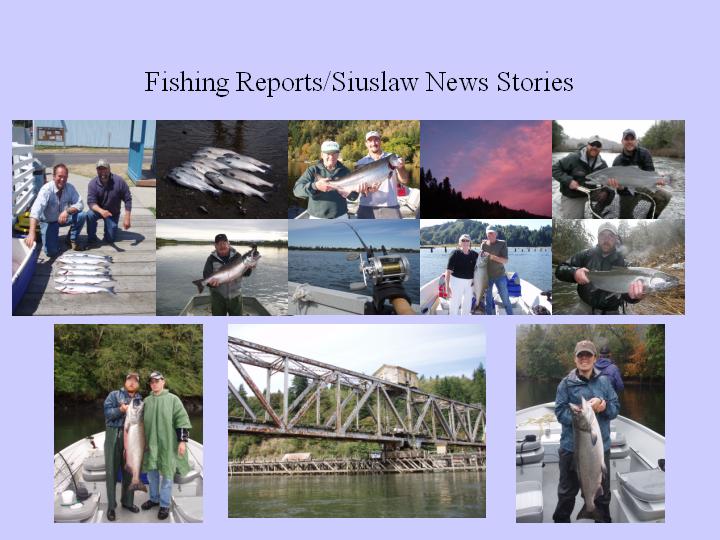
Due to anticipated poor returns, ODFW Commission members are expected to adopt some of the most restrictive fall chinook fishing regulations ever forwarded by biologists. Recommendations include reduced bag limits, new angling deadlines and the closure of the Nehalem basin to all chinook fishing. The Nehalem River is (was) home to one of the biggest chinook runs on the north Oregon coast. And while chinook fishing will be even more limited than last year, ODFW staff is recommending wild coho fisheries in tidewater portions of several different river systems – including the Nehalem, Yaquina, Coos and Coquille Rivers.
Why Are Coho Up And Chinook Down?
Chinook and coho salmon have different life histories, which makes it possible for these very similar species to return at different rates. Chinook and coho have different age structures – coho salmon return almost exclusively as 3 year-old fish, with a small number returning as 2 year-olds (jacks). Conversely, 4 and 5 year-old fish make up a significant part of the chinook return. Favorable ocean conditions have only taken hold (again) since 2007. This means that a large part of this year’s returning chinook headed into bad ocean conditions as juveniles, thus experienced higher mortality and lower overall returns. The coho salmon, with less turnaround, went to sea in better conditions and we are seeing greater returns. All things being equal (and we know they’re not), we will see a better return of fall chinook starting in 2010.
Commission Is A Wild Card
The ODFW Commission does not always follow staff recommendations, especially on controversial issues. For instance, on the Nehalem River how can you allow fishing for coho while chinook is shut down completely? How do you minimize the impact on chinook? Certainly some will be caught (and killed) incidentally? Also, Oregon Coast coho salmon are listed as threatened under the Endangered Species Act. The model of Siltcoos and Tahkenitch lakes does not fit the Nehalem fishery because on the lakes, there’s no chance of depleting an imperiled chinook run.
Regulations Not Much Different Than Last Year
Don’t expect any changes from last year’s regulations: the daily/season limit for chinook will most likely be 1/5 again this year. Also, angling is likely to be closed on Lake Creek, the mainstem above Lake Creek and on NF Smith River.
As always, your thoughts, calls, and e-mails are welcome on this and other related issues.
See you on the water,
Action Jackson
(Please send comments or questions to Action Jackson at 268-6944 or www.actionjacksonfishing.com)
Wednesday, June 3, 2009

Monday, June 1, 2009
Now A Good Time For Stream Trout Fishing
During the past few days, people have been asking about where to go to catch some nice trout. My first instinct was to tell them about the many local lakes that have been or will be stocked. Mercer, Munsel, Alder, Cleawox and others are regularly stocked with catchable rainbow trout, with some “trophy” fish also available. These lakes can have some fast action and are good places to introduce kids to fishing. But there are other options. If you’re looking for an adventure, fewer people and a chance to see the beauty the Oregon Coast Range offers, head for one of the many streams that just opened up to trout fishing over the weekend.
Check Regulations Before Heading Out
The Oregon Dept. of Fish and Wildlife fishing regulations can sometimes be confusing, but if you take just a few minutes you can figure out the applicable rules for the stream you want to fish. There’s even a map that shows which streams are open. Be aware that many streams are closed to the use of bait, including nightcrawlers and eggs. This is to protect the juvenile salmon and steelhead, which are still in streams in large numbers. The ODFW regulations will also point you in the right direction on places to fish. Many tributaries of the Siuslaw River are open to trout fishing – including Sweet, Lake, Indian and Deadwood Creeks. The water levels are low enough to allow wading for long stretches. There’s no better way to cool off during a hot summer day.
Gearing Up
If you’re spin-fishing, small spinners are a great way to catch cutthroat trout. Silver, gold, copper and black have always been top colors for me. Please consider using single, barbless hooks when trout fishing as treble hooks can really make for a tough release for smaller fish. Concentrate on moving water – riffles offer cover and food and are a great place to find fish. An ultra-light rod and reel combination with 4-6 lb. test line is perfect for summer trout fishing. Another tip – fishing early and late often produces the best fishing. Another great way to catch stream trout is with a fly rod. Try small bead-heads and other nymphs fished under an indicator in riffles and tailouts.
Trout fishing in streams is one of the most rewarding forms of fishing. Wading the streams in summer gives you the chance to see all kinds of wildlife, get away from the crowds and maybe catch a few hard fighting and tasty cutts.
See you on the water,
Action Jackson
(Please send comments or questions to Action Jackson at 268-6944 or www.actionjacksonfishing.com)
Thursday, May 21, 2009
Getting Your Boat Ready For The Season
Its that time of year again. Its time to remove your boat cover, hose out your boat, and get ready to take family and friends to the lake for a summer full of fish and fun. Maybe you’re a new boat owner wondering what you need to be comfortable and safe on the river. Fear not friends, for Action Jackson is about to tell you what you need and what you’ll want to have on the water.
Before You Leave Home
Proper engine maintenance is the key to well-performing and long-living outboard motors. Change your engine’s oil and filters. Drain and refill gear lube. Check spark plugs, hoses running to fuel tanks and battery connections. Check trailer lights, trailer tires and lubricate trailer wheel bearings. Trailers take a beating year after year and are often overlooked when preparing the boat for the upcoming season. A blown tire or frozen wheel bearings can be very dangerous. Take the time to check your trailer, or take it in to folks who specialize in tires and wheels. Many modern outboard motors can be connected to a garden hose (with “ear” muffs, which use suction cups to feed water to your motor’s lower unit intake) and allow you to test your motor in the driveway. Start up your motor and make sure everything works as it should. I also recommend having a small tool box in the boat with some emergency supplies (screwdrivers, socket set, extra spark plugs, spare boat plug, duct tape, zip ties, pliers). Even if you aren’t mechanically inclined, you’ll be able to tighten up a bolt or stop a leak in a gas line.
Safety First
Depending on the size of your boat, federal and state regulations require different life saving equipment. Boats less than 16 feet (including canoes, kayaks and rafts) must have a Type I, II, or III personal flotation device for every person on board. Boats over 16 feet (except for canoes and kayaks) must have, in addition to PFDs for every person, must have a Type IV throwable flotation device. All flotation devices must be readily available for persons on board. My advice is to spend a little extra to get PFDs that are more comfortable and WEAR THEM AT ALL TIMES. Children under 12 must wear flotation devices at all times, NO EXCEPTIONS. For kids, make sure flotation devices fit properly and are comfortable.
Motor boats are also required to carry lights, fire extinguishers and emergency signal devices. The Oregon State Marine Board has a great website that lists complete requirements, based on boat length, http://www.boatoregon.com/Laws/Requirements.html. You can also call them at (503) 378-8587 for more information.
Another overlooked safety item is an anchor and anchor rope. Imagine crabbing near the mouth of the Siuslaw River when the motor suddenly dies. You could be pushed against the jettys or swept out to the bar before help arrives. An anchor might make the difference between a close call and disaster. And while an anchor might not hold in strong winds and currents, it will at least slow the boat down.
A Word About Boater Education
This year, all boaters regardless of age will be required to carry Operator’s cards. According to the Oregon State Marine Board website, citations for non-compliance have increased to $94. Younger boaters (less than 15 years old) also are restricted in certain ways. Courseroom classes are available statewide and will teach folks something new, guaranteed. You can also take a Marine Board-mandated test online. More information can be found on the Boat Oregon website http://www.boatoregon.com.
See You On The Water,
Action Jackson
(Please send comments or questions to Action Jackson at 268-6944 or www.actionjacksonfishing.com)
Wednesday, May 13, 2009
Nature Has Its Reasons
Over the past several weeks, I’ve had the pleasure of introducing Siuslaw Elementary’s 4th graders to the Smolt Trap—and teaching them about the work we do there. When we talk about the salmon, steelhead and cutthroat trout that make up a majority of the catch, I am amazed by how much the kids know. While most of the conversations are about anatomy, physiology and natural history, ultimately some of the discussions veer toward the cruelty of nature. Kids ask questions like, “do the fish eat each other?” and “why do the fish have to die after they spawn?” Some of the questions I get are so profound that I couldn’t begin to address them in a few hundred words. What I can do is offer some insight about why nature’s cruelty is necessary.
You’ve Got Two Chances: Slim and None (And Slim Just Swam Away)
Even before a salmon hatches, it is already a highly sought after food source. Other fish will attempt to feed on the eggs as they’re being deposited in the gravel. Cutthroat trout will stage behind spawning salmon in an attempt to pick up eggs. For the trout, eggs are a nutritious and plentiful food source that will help them put on the extra energy needed for their own upcoming spawn. As the salmon fry emerge from the gravel, trout, sculpin and larger juvenile salmon are all looking to feed on them. Blue herons and kingfishers expertly wait for recently hatched fish as well.
Not only do salmon fry have to survive the onslaught of predators, they must somehow survive flood conditions that can suffocate, crush, or leave them stranded in an isolated pool to be found by a raccoon or wash them downstream before they are prepared.
On their migration downstream, behind every boulder and logjam, in every riffle and pool, in front, behind, below and above them, awaits another potential predator. One of the saving graces for these fry is that they tend to migrate in large numbers. So while large numbers fall prey, some are able to make it to the next stage of the journey.
This all sound harsh to us humans, but it’s nature’s way of making sure only the best survive. The slow, the weak, the small, the careless (and the unlucky) never even make it out of Knowles Creek. And the trials don’t end—ever. Once juveniles make it to the main river, gulls, cormorants, otters, larger trout, pikeminnow and many other predators take their turn at weeding out the weak. All this time, juvenile salmon have to worry about their food, looking for invertebrates and smaller fish on which to feed.
By the time the juvenile salmon reach saltwater, things aren’t any easier. Maturing salmon have to be fortunate enough to find plentiful food and dodge the many predators. Seals and sea lions, orcas, salmon sharks and, another effective predator, man, all take ocean salmon in large numbers. As adult salmon stage in the ocean and in their home rivers, commercial and sport fisherman further reduce the salmons’ numbers. Being taken out of the mix in this case is more about bad luck for a salmon than a comment on its overall fitness.
What I tell the 4th graders is this: nature has its reasons for taking so many of the young salmon. It’s to help the next generation of salmon be as strong as possible. Only the best are able to make it home to spawn.
See you on the water,
Action Jackson
(Please send comments or questions to Action Jackson at 268-6944 or www.actionjacksonfishing.com)
Wednesday, May 6, 2009
Invited Out On A Friend’s Boat? Some Things To Keep In Mind
As we all know, many anglers are boat-less. Let’s face it: there are better investments out there. From storage and maintenance to a truck to pull the boat to state fees and the recent boating license, I can see why so many anglers choose not to have one. Just because you don’t have a boat doesn’t mean you can’t team up with a friend or neighbor who does have a boat. It’s a relationship that can be mutually beneficial. If you’re invited aboard a friend’s boat for the first time, it can be a little weird. Here’s a few things to keep in mind that will (hopefully) get you invited back for future trips.
Before/During The Trip
There are lots of arrangements to take care of ahead of time. Coordinate with the boat owner to make sure you know where you are meeting and at what time. DON’T BE LATE! The people I fish with know that I am always early and ready to go. Be the same way. Other things to consider:
· Before the trip is a good time to make food arrangements. If you bring food, have enough to share with the other folks on the boat.
· Make sure the boat owner has a PFD (life jacket) for you. If not, bring one. If the boat is stopped and ticketed for not having enough safety equipment, it will be the boat owner who pays.
· Do not bring uninvited guests. This includes dogs. Clear it with the boat owner first.
· Ask about what gear you need to bring and don’t bring other stuff. A boat cluttered with extra poles, tackle boxes and coolers is a hassle.
· Offer to get the bait. Find out what kind, what size and ask where to get it. Find out if it needs to be thawed or frozen. Bring enough for everyone on board.
· Be considerate with trash and dropped food/drink. Even though a boat owner might not admit it, we really hate to see potato chips and soda spilled everywhere.
· Help with the launch and retrieval of the boat.
· Last, and definitely not least, don’t dictate what time you have to be off the water. If you’re going out, assume its all day. It is really annoying to have someone on the boat who wants to get back to the dock by 5:00 so they can catch a movie. This is very poor etiquette. We understand that other things need to get done. But don’t accept the invitation unless you can stay out.
I Probably Don’t Need To “Chip In” (He Was Going Fishing Anyway)
There are many, many costs associated with owning and operating a boat. The price of fuel seems to be going up every day. There are launch and parking fees to be paid. Offer to pay your share or more. To feel that someone was “going anyway” and so you don’t need to chip in is a great way not to be invited back. The boat owner may or may not accept your money, but make sure to pitch in.
When I’m trolling the river in the fall, I see many boats with just one person aboard. With so many folks out there crazy about fishing, surely there’s someone out there to help split the cost of fuel and help you clean up afterward. There’s a lot of room in this topic for a future article, so feel free to drop me a line and let me know how you operate, boat owner and boat-less alike.
See you on the water,
Action Jackson
(Please send comments or questions to Action Jackson at 268-6944 or www.actionjacksonfishing.com)
Wednesday, April 29, 2009
Rumors Swirl Regarding Fall Salmon Regulations
The fate of fall salmon fishing on Oregon coast rivers will be decided during the next few weeks. There are rumors surfacing that Oregon Dept. of Fish and Wildlife has already decided to close certain rivers to chinook fishing for 2009. Who would’ve believed it? The Siuslaw River is (was) home to one of the strongest runs of fall chinook on the coast. Just a few short years ago we had a fall run that was estimated to be near historic highs. And though some of you may want to run me out of town, I’m going to say it anyway: if predicted adult returns do not meet minimum standards, then I am in favor of closing all rivers this fall, including the Siuslaw.
Don’t You Make Money By Taking People Fishing?
As a fishing guide, I book approximately 70% of my trips from Aug-Oct. Fall chinook fishing is by far my most popular season. Not only does fall fishing carry me through slower seasons financially, it also brings tourists in from all over Oregon and the United States. Tourism is big business here, and salmon bring people to the Oregon coast. Those people spend money in our hotels and restaurants. So you like to go fishing and a closure will affect you? I need to go fishing to support my family. I do not take this lightly.
Worst Case Scenario
I am concerned that some rivers on the coast will be closed this fall while the Siuslaw remains open. A great deal of effort will shift to this river, which would be bigger crowds. It is not unreasonable to believe effort could double or triple on the Siuslaw. It is unclear whether or not local businesses would benefit as a large number of new anglers would be coming from close by metro areas like Salem and Portland. So while rivers north and south of the Siuslaw would be getting a break, twice as many anglers would be putting twice as much pressure on a fishery that might not be able to support the pressure. And you think other boaters were rude last year? What’s this? Tons of boats were fishing around Cushman? Brother, you ain’t seen nothin’ yet.
Let The Facts Make The Decisions
While forecasting run size is inexact, fisheries scientists are getting more accurate. Biologists take into account factors such as commercial fishing take, outmigration of juveniles, predation, minimum escapement for sustaining runs and anticipated angling pressure. If, and only if these factors point to the need for an emergency closure, then that is what needs to take place. I would rather be conservative, closing the river if there’s a chance of doing real damage to our run. And if the facts show that this fall’s run can support the pressure, I’ll be the first to push for keeping the river open.
Will we be the generation that is pointed to 100 years from now as the one that destroyed fall chinook fishing on the Siuslaw? I hope not. I’ve worked too hard on habitat restoration projects, tree plantings and other fisheries projects to let greed and short term gains get the better of me. I refuse to put my self interest above that of future generations.
Give Your Opinion On Upcoming Fall Chinook Season
The public is invited to give their opinion regarding the upcoming fall salmon seasons in rivers and lakes. Please write, e-mail or call Bob Buckman, ODFW biologist if you can attend the meeting. Here’s the specifics on the meeting:
When: April 29
Where: Hallmark Resort Newport, 744 Elizabeth, Newport
Contact: Bob Buckman, ODFW, (541) 265-8306 x224, robert.c.buckman@state.or.us
See you on the water,
Action Jackson
(Please send comments or questions to Action Jackson at 268-6944 or www.actionjacksonfishing.com)
Wednesday, April 22, 2009
News From Around The Area
There sure is a lot to talk about this week: the possibility of Black Rockfish limits being raised, adoption of Fall Chinook fishing regulations. Let’s get started with warmwater fishing and clarification of my stance on bass and panfish.
Action Jackson Doesn’t Hate Bass And Doesn’t Keep Cormorants As Pets
I recently became aware that many local warmwater fishermen weren’t too happy with me lately. I wrote an article a few weeks ago about non-native fish in this area and urged anglers to keep a limit of bass the next time they go fishing. My comments were largely directed at the Smallmouth bass fishery on the Umpqua River, where bass numbers are out of control. It’s nothing to go there during the summer and catch 100 fish in a day. These fish are very aggressive and there is no doubt they impact salmon and steelhead numbers through predation and competition for food and habitat. Catch and keep a limit of Smallmouth bass this summer on the Umpqua. As far as warmwater fishing on our Central Coast lakes, things appear to be different. The once numerous schools of Yellow perch and White crappie seem to have disappeared. Largemouth bass numbers are way down. I have had several calls and e-mails pointing to one reason: cormorants. Double-Crested cormorant numbers have skyrocketed over the last 20 years, and many birds can be found on Siltcoos Lake year-round. From the research I have been able to do online, population control will be unlikely in the near future. Cormorants are federally protected through the Migratory Bird Treaty Act. Hazing measures might be a viable alternative. Anglers in Tillamook Bay have hired someone to cruise around on a jet ski to disturb flocks of feeding birds into flying somewhere else. Before I’d suggest looking into a similar program here I’d really like to know some results of the jet ski hazing. I also recently received a letter regarding the possibility of state legislation looking into cormorant predation problems and solutions. Readers, this issue is still very much in the front of my mind and you haven’t heard the last of it.
Black Rockfish Limit Being Raised?
There’s a strong possibility that Black Rockfish limits will be raised in the near future from 6 to 7 fish per day. Opponents of Marine Reserves are pointing to an increased bag limit as a victory for Fisheries Managers and reason to dismiss all talk of MRs. I’m not 100% convinced. Ocean conditions have been excellent for Black Rockfish recently and surely have played a part in increased numbers. I say enjoy an increased limit and partake in the fishery, but also realize that gains might only be short-term.
Give Your Opinion On Upcoming Fall Chinook Season
The public is invited to give their opinion regarding the upcoming fall salmon seasons in rivers and lakes. Please write, e-mail or call Bob Buckman, ODFW biologist if you can attend the meeting. Here’s the specifics on the meeting:
When: April 29
Where: Hallmark Resort Newport, 744 Elizabeth, Newport
Contact: Bob Buckman, ODFW, (541) 265-8306 X224
Chinook numbers aren’t expected to be much higher than the last 2 years is the word I’m getting. With this in mind, I am advocating that last year’s closures of Lake Creek and the Siuslaw River above Lake Creek be made permanent. There has been numerous problems with snagging, poaching and fishing over salmon past their prime for eating. Our chinook runs need places like Lake Creek when numbers are down. Closing Lake Creek will help ensure salmon will return to the Siuslaw for our grandchildren and their grandchildren to enjoy.
See you on the water,
Action Jackson
(Please send comments or questions to Action Jackson at 268-6944 or www.actionjacksonfishing.com)
Subscribe to:
Posts (Atom)