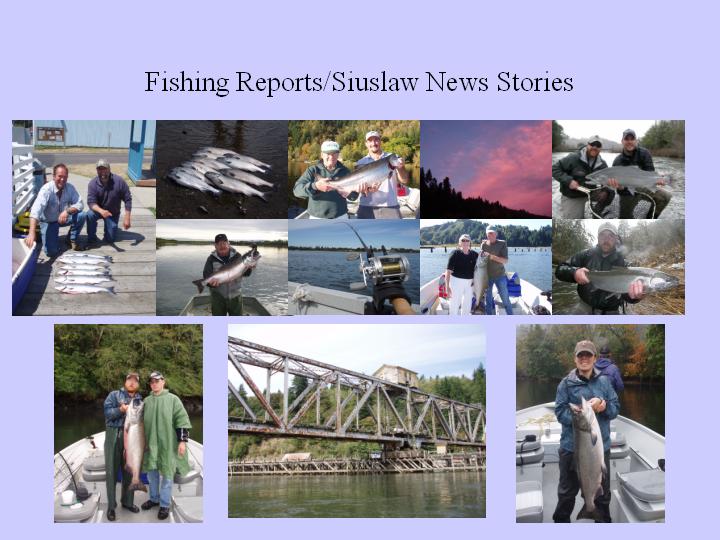
In last week’s article, I wrote about ODFW accepting input on sportfishing regulation changes (from Dec. 1, 2007-Feb. 29, 2008). Input can come from any interested party. Materials can come from the ODFW website at www.dfw@state.or.us or write them at: Angling Regulations, 3406 Cherry Ave. NE, Salem, OR 97303. Over the past few months I have suggested sportfishing regulation changes that I feel are needed here on the Siuslaw. I’m putting them together here in case anyone else out there feels the same as I do and would like to tell the state so.
Drop The Limit To 10 Wild Fish Per Season
As it stands right now, an angler could fill the 20 spots on their tag all with wild chinook from the Siuslaw River if they wanted. In years when the run is depressed (such as 2007), that is too many. On other coastal systems in Oregon, there are limits on how many wild chinook may be taken per year. Only 10 fish per season can be taken from all Nehalem, Tillamook and Nestucca bays and streams. These are large systems that produce a lot of fish. The Siuslaw is getting more and more pressure every year.
Ten wild chinook from the Siuslaw per season is more than enough. The remaining 10 spots on the tag could be used for halibut, sturgeon or hatchery fish. And if that’s not enough for you, buy a Hatchery Harvest Tag which allows you to harvest 10 more hatchery salmon and steelhead. The cost is $12 and there’s no limit on the number of tags you can buy.
Time To Close Upper Siuslaw and Lake Creek
It may be time that ODFW consider closing portions of Lake Creek and the Siuslaw until later in the season. Many salmon fishermen without a boat depend on fishing these areas, and that fresh salmon can be caught there, even in low water. But snagging is a problem that needs to be addressed. If the Siuslaw was closed from the confluence of Lake Creek upstream until December 1, there would still be plenty of good locations folks could reach from the bank. Here’s a story that might make your stomach turn: a large, dark chinook was brought in just because the guy who caught it thought it was big enough to win a big fish contest. After weighing it and figuring out it wasn’t big enough to win, he tried to give it away to people in the store. Obviously the only reason he kept it was for the contest. If you aren’t going to give that fish the respect it deserves, then don’t fish. I hope the carcass ended up back in the stream, but chances are it ended up in the bushes somewhere between Mapleton and Deadwood. Close spots where people can target dark fish. Close Lake Creek and the Upper Siuslaw until later in the fall.
See you on the water,
Action Jackson
(Please send comments or questions to Action Jackson at 268-6944 or www.actionjacksonfishing.com)
Thursday, February 7, 2008

Thursday, January 31, 2008
Buy Your 2008 License, Check The Regulations For Changes
If you haven’t already done so, now is a great time to buy your 2008 fishing license (and also salmon/steelhead tag and shellfish license). This year’s Angling License is $24.75 for residents, and the Combined Angling Tag (for harvesting salmon, steelhead, sturgeon and Pacific halibut) is $21.50. Oregon is once again offering a Hatchery Harvest Tag, which can be used to record adult hatchery salmon and steelhead for $12.00. This is a great deal if you plan on fishing in the ocean or fishing rivers with Broodstock fish (like the Siuslaw). Also, there’s no limit on the number of Hatchery Harvest Tags you can purchase. The Resident Shellfish License, which you need to crab, clam and pump sandshrimp, is available for $6.50.
Regulation Changes In Our Area
Most streams that open for trout fishing do so on May 24 this year. The major change in the regulations this year is that the coho fishery in Siltcoos and Tahkenitch Lakes is in the book this year. Since this fishery was re-opened a few years ago, the state has waited until after the regulations were published to make the announcement. The numbers of returning fish have been strong enough over the last few years to add this change to the hard copy regulations. We should be thrilled that we have access to the only wild coho fishery in Oregon. Open dates are Oct. 1-Dec. 31.
State Seeking Input On Proposed Regulation Changes
Every four years ODFW invites anglers (and all interested parties) to review and develop angling regulations. From Dec. 1, 2007-Feb. 29, 2008 ODFW will accept angling regulation proposals from anyone interested. To receive materials from ODFW, visit their website at www.dfw@state.or.us or write them at: Angling Regulations, 3406 Cherry Ave. NE, Salem, OR 97303. Public meetings will be held in May to discuss proposals. The two closest locations to our area are Springfield and Newport. For meeting locations and times, check the Siuslaw News or and ODFW office during the first week of May. I’ll also try to make sure to post locations and times in Keepin’ It Reel. When the Fish and Wildlife Commission meets in August, they will discuss proposals and adopt some (hopefully) in September. All Commission meetings are open to the public and public participation and testimony are encouraged.
See you on the water,
Action Jackson
(Please send comments or questions to Action Jackson at 268-6944 or www.actionjacksonfishing.com)
Regulation Changes In Our Area
Most streams that open for trout fishing do so on May 24 this year. The major change in the regulations this year is that the coho fishery in Siltcoos and Tahkenitch Lakes is in the book this year. Since this fishery was re-opened a few years ago, the state has waited until after the regulations were published to make the announcement. The numbers of returning fish have been strong enough over the last few years to add this change to the hard copy regulations. We should be thrilled that we have access to the only wild coho fishery in Oregon. Open dates are Oct. 1-Dec. 31.
State Seeking Input On Proposed Regulation Changes
Every four years ODFW invites anglers (and all interested parties) to review and develop angling regulations. From Dec. 1, 2007-Feb. 29, 2008 ODFW will accept angling regulation proposals from anyone interested. To receive materials from ODFW, visit their website at www.dfw@state.or.us or write them at: Angling Regulations, 3406 Cherry Ave. NE, Salem, OR 97303. Public meetings will be held in May to discuss proposals. The two closest locations to our area are Springfield and Newport. For meeting locations and times, check the Siuslaw News or and ODFW office during the first week of May. I’ll also try to make sure to post locations and times in Keepin’ It Reel. When the Fish and Wildlife Commission meets in August, they will discuss proposals and adopt some (hopefully) in September. All Commission meetings are open to the public and public participation and testimony are encouraged.
See you on the water,
Action Jackson
(Please send comments or questions to Action Jackson at 268-6944 or www.actionjacksonfishing.com)
Thursday, January 24, 2008
Change Your Approach In Low, Cold Water
What a difference a few days can make. During the first part of January, I discussed high water techniques (plunking) for steelhead. With the lack of rain lately, the fish are still around, but you’ll need to rethink your approach to consistently catch fish. Here are a few tips that are sure to help.
Downsize Your Offering
Steelhead can be spooky in low water. Try using small baits of eggs (dime-sized baits), small corkies (or sometimes no corkie), 1/8 or 1/16 oz. jigs, and smaller plugs. With increased water clarity, steelhead will notice smaller offerings and not be turned off. I will often use size 4 or even size 6 hooks in very clear water. A good choice in clear water is a small clump of eggs under a bobber. Use a small piece of split shot to keep the bait down.
Lighter Leader Makes A Difference
Downsize your leaders to catch spooky fish. I commonly use 8 lb. test. Another good option is florocarbon for leader. Florocarbon is almost invisible under water and you can use the same knots that you use when tying monofilament. Also, it is very strong stuff. These conditions are also perfect to use a longer leader. Try fishing a 4-foot leader to trick spooky fish. When fishing plugs, get them further back from the boat so you’re not scaring fish.
Try Fishing Later In The Day
Steelhead tend to be lethargic in cold (below 40 degrees) water. Let everybody else fight the icy roads and frozen rod guides. After the crowds have thinned and the water warms up, give it a try. The fish that weren’t moving first thing in the morning will become more active after the sun comes up. Concentrate on tailouts and slower, deeper runs to find fish.
Other Tips
And speaking of frozen rod guides, try spraying Pam® Cooking Spray on the guides before you start fishing. I’ve heard of other solutions such as Vaseline and silicon-based sprays, but Pam seems to be a good solution. Always have a dry towel handy so your hands don’t freeze. Also, make sure you have plenty of pre-tied leaders. The last thing you want to do is try to tie an egg loop with light line when you can’t feel your fingers.
Fishing Good On the Siuslaw
Steelhead fishing in the Whittaker Creek-Linslaw area has been good. Use your favorite technique as everything is producing. This area is very snaggy, so think about using methods that will keep you off the bottom, such as jig/bobber, plugs and spoons/spinners. Also, the Wildcat launch is now a parking permit area (Lane Co.). Buy your permit ahead of time to avoid an expensive ticket.
See you on the water,
Action Jackson
(Please send comments or questions to Action Jackson at 268-6944 or www.actionjacksonfishing.com)
Downsize Your Offering
Steelhead can be spooky in low water. Try using small baits of eggs (dime-sized baits), small corkies (or sometimes no corkie), 1/8 or 1/16 oz. jigs, and smaller plugs. With increased water clarity, steelhead will notice smaller offerings and not be turned off. I will often use size 4 or even size 6 hooks in very clear water. A good choice in clear water is a small clump of eggs under a bobber. Use a small piece of split shot to keep the bait down.
Lighter Leader Makes A Difference
Downsize your leaders to catch spooky fish. I commonly use 8 lb. test. Another good option is florocarbon for leader. Florocarbon is almost invisible under water and you can use the same knots that you use when tying monofilament. Also, it is very strong stuff. These conditions are also perfect to use a longer leader. Try fishing a 4-foot leader to trick spooky fish. When fishing plugs, get them further back from the boat so you’re not scaring fish.
Try Fishing Later In The Day
Steelhead tend to be lethargic in cold (below 40 degrees) water. Let everybody else fight the icy roads and frozen rod guides. After the crowds have thinned and the water warms up, give it a try. The fish that weren’t moving first thing in the morning will become more active after the sun comes up. Concentrate on tailouts and slower, deeper runs to find fish.
Other Tips
And speaking of frozen rod guides, try spraying Pam® Cooking Spray on the guides before you start fishing. I’ve heard of other solutions such as Vaseline and silicon-based sprays, but Pam seems to be a good solution. Always have a dry towel handy so your hands don’t freeze. Also, make sure you have plenty of pre-tied leaders. The last thing you want to do is try to tie an egg loop with light line when you can’t feel your fingers.
Fishing Good On the Siuslaw
Steelhead fishing in the Whittaker Creek-Linslaw area has been good. Use your favorite technique as everything is producing. This area is very snaggy, so think about using methods that will keep you off the bottom, such as jig/bobber, plugs and spoons/spinners. Also, the Wildcat launch is now a parking permit area (Lane Co.). Buy your permit ahead of time to avoid an expensive ticket.
See you on the water,
Action Jackson
(Please send comments or questions to Action Jackson at 268-6944 or www.actionjacksonfishing.com)
Thursday, January 17, 2008
South Coast Monster Spotted!


Last weekend 2 good friends and I headed down to one of our favorite south coast rivers. We weren't expecting much as the river was still high and off color. The first half of the day produced nothing. Todd casted his eggs into some soft water and fish on! This beast, estimated at 38 inches and 20-22 lbs. dragged us down river for nearly 300 yards until we could find a place to land it. Good thing we were in a boat.
Here's this weeks Siuslaw News story...
High Water Options for Steelhead and Salmon – Part III
During the last couple of weeks, I began discussing some high water techniques for catching salmon and steelhead. This week, I’ll discuss in more detail rigging and bait selection for plunking. As always, if you missed the article (or any others) please send me an e-mail and I’ll send you a copy.
Let’s Recap
On the mainline (running to the rod), place a 3mm bead, a plastic slider (or barrel swivel), another 3mm bead, and tie another barrel swivel. The slider between the beads is where you’ll run the dropper for the weight. Tie a 12” piece of fishing line (8 lb. test) to the barrel swivel, and tie a stout rubber band to the other end. Now, tie up an egg loop, add a 5 mm bead (to keep things spinning) and place your favorite spin-n-glo® on the leader and tie it to the barrel swivel that’s attached to the mainline. I usually use shorter leaders, approximately 24-30 inches. Salmon and steelhead in dirty water aren’t leader shy, so you can get away with shorter leaders and use heavier line (try 12-15 lb. test monofilament).
Hooks, Bait and Whatnot
Like I said above, my experience has been that these fish aren’t shy, and large baits are better in high water. You want lots of scent so it’s easy for fish to find your presentation. Tie your egg loops on larger hooks (4/0-6/0) and use large clumps of eggs (quarter-size clumps). Don’t be afraid to add scent. Check your offering at least every 30 minutes as high water moves more than fish – leaves and twigs moving downriver will foul your bait.
You Don’t Have To Be “Way Out”
Remember, salmon and steelhead moving upriver in high water will come up right along the edge of the main flow. Depending on where you set up, this can be as close as 5 feet from the water’s edge! Place your bait in the soft water, right on the edge of the main flow. I’ll often pick my spot to plunk where rapids or heavy water create a distinct edge. Every fish moving upriver will pass your bait!
If any of the rigging I discuss sounds confusing, give me a call and I’ll help you sort it out. And please join me next week when I talk about another current topic.
See you on the water,
Action Jackson
(Please send comments or questions to Action Jackson at 268-6944 or www.actionjacksonfishing.com)
During the last couple of weeks, I began discussing some high water techniques for catching salmon and steelhead. This week, I’ll discuss in more detail rigging and bait selection for plunking. As always, if you missed the article (or any others) please send me an e-mail and I’ll send you a copy.
Let’s Recap
On the mainline (running to the rod), place a 3mm bead, a plastic slider (or barrel swivel), another 3mm bead, and tie another barrel swivel. The slider between the beads is where you’ll run the dropper for the weight. Tie a 12” piece of fishing line (8 lb. test) to the barrel swivel, and tie a stout rubber band to the other end. Now, tie up an egg loop, add a 5 mm bead (to keep things spinning) and place your favorite spin-n-glo® on the leader and tie it to the barrel swivel that’s attached to the mainline. I usually use shorter leaders, approximately 24-30 inches. Salmon and steelhead in dirty water aren’t leader shy, so you can get away with shorter leaders and use heavier line (try 12-15 lb. test monofilament).
Hooks, Bait and Whatnot
Like I said above, my experience has been that these fish aren’t shy, and large baits are better in high water. You want lots of scent so it’s easy for fish to find your presentation. Tie your egg loops on larger hooks (4/0-6/0) and use large clumps of eggs (quarter-size clumps). Don’t be afraid to add scent. Check your offering at least every 30 minutes as high water moves more than fish – leaves and twigs moving downriver will foul your bait.
You Don’t Have To Be “Way Out”
Remember, salmon and steelhead moving upriver in high water will come up right along the edge of the main flow. Depending on where you set up, this can be as close as 5 feet from the water’s edge! Place your bait in the soft water, right on the edge of the main flow. I’ll often pick my spot to plunk where rapids or heavy water create a distinct edge. Every fish moving upriver will pass your bait!
If any of the rigging I discuss sounds confusing, give me a call and I’ll help you sort it out. And please join me next week when I talk about another current topic.
See you on the water,
Action Jackson
(Please send comments or questions to Action Jackson at 268-6944 or www.actionjacksonfishing.com)
Wednesday, January 9, 2008
High Water Options for Steelhead and Salmon – Part II
In last week’s article, I began discussing some high water techniques for catching salmon and steelhead. Don’t be put off by the high water as these fish can still be caught! If you missed the article (or any others) please send me an e-mail and I’ll send you a copy.
I Know Where They’ll Be, So How Do I Catch ‘Em?
The method I favor when the water is high is known as plunking. In its simplest form, you place the bait in the water, put your rod down, and wait for the fish to grab the bait. There’s a little more to it the way I do it, but by no means is it “Rocket Science”. Start by using a 7 to 9-foot heavy action rod spooled with at least 30 lb. test monofilament fishing line. On the mainline (running to the rod), place a 3mm bead, a barrel swivel, another 3mm bead, and tie another barrel swivel. The barrel swivel between the beads is where you’ll run the dropper for the weight. Tie a 12” piece of fishing line (8 lb. test) to the barrel swivel, and tie a stout rubber band to the other end. The reason you’re using a lighter line going to your weight is because if the weight gets stuck, you can break it off without losing your whole setup. The reason you’re tying a rubber band on the dropper line is because you’re using a rock for weight instead of a traditional lead sinker that many use. What?!?! A rock for weight?!?! How can this be? Let me tell you why. First rock cheaper than lead. Rock free. Rock work good. Use lose rock, you get other rock. Secondly, when the fish takes the bait, the rubber band will often free from the rock, leaving you to fight just the fish and not the lead. Finally, and many anglers won’t want to admit it, but lead is not good for the river. The impacts of lead are well documented. I would be hypocritical if I bashed others for using it, because I do use it sometimes. BUT, I try not to lose any in the river and use alternatives when I can. Besides, while lead is still pretty cheap, rocks are free! Select one right for the water conditions, meaning one that will keep your bait on the bottom, but not so heavy that you can’t pick it up. Often, a golf ball-sized rock a few ounces will do. Now, double that rubber band around the rock and you have your weight. The reason the dropper line is attached to a swivel is so when a fish takes the bait, it won’t feel the weight, which might make a shy fish think twice.
If any of the rigging I discuss sounds confusing, give me a call and I’ll help you sort it out.
See you on the water,
Action Jackson
(Please send comments or questions to Action Jackson at 268-6944 or www.actionjacksonfishing.com)
I Know Where They’ll Be, So How Do I Catch ‘Em?
The method I favor when the water is high is known as plunking. In its simplest form, you place the bait in the water, put your rod down, and wait for the fish to grab the bait. There’s a little more to it the way I do it, but by no means is it “Rocket Science”. Start by using a 7 to 9-foot heavy action rod spooled with at least 30 lb. test monofilament fishing line. On the mainline (running to the rod), place a 3mm bead, a barrel swivel, another 3mm bead, and tie another barrel swivel. The barrel swivel between the beads is where you’ll run the dropper for the weight. Tie a 12” piece of fishing line (8 lb. test) to the barrel swivel, and tie a stout rubber band to the other end. The reason you’re using a lighter line going to your weight is because if the weight gets stuck, you can break it off without losing your whole setup. The reason you’re tying a rubber band on the dropper line is because you’re using a rock for weight instead of a traditional lead sinker that many use. What?!?! A rock for weight?!?! How can this be? Let me tell you why. First rock cheaper than lead. Rock free. Rock work good. Use lose rock, you get other rock. Secondly, when the fish takes the bait, the rubber band will often free from the rock, leaving you to fight just the fish and not the lead. Finally, and many anglers won’t want to admit it, but lead is not good for the river. The impacts of lead are well documented. I would be hypocritical if I bashed others for using it, because I do use it sometimes. BUT, I try not to lose any in the river and use alternatives when I can. Besides, while lead is still pretty cheap, rocks are free! Select one right for the water conditions, meaning one that will keep your bait on the bottom, but not so heavy that you can’t pick it up. Often, a golf ball-sized rock a few ounces will do. Now, double that rubber band around the rock and you have your weight. The reason the dropper line is attached to a swivel is so when a fish takes the bait, it won’t feel the weight, which might make a shy fish think twice.
If any of the rigging I discuss sounds confusing, give me a call and I’ll help you sort it out.
See you on the water,
Action Jackson
(Please send comments or questions to Action Jackson at 268-6944 or www.actionjacksonfishing.com)
Saturday, December 29, 2007
Steelhead Starting to Show


Greetings Anglers,
Winter steelhead are starting to show in good numbers on the Oregon Coast. These are just two of the several wild beauties hooked earlier this week. All your favorite techniques will work on these aggressive fish.
Here's this week's Siuslaw News story...
High Water Options for Steelhead and Salmon
We’ve all been there – you work hard all week and wait anxiously for the weekend. It starts raining Thursday night and pours all day Friday. By Saturday morning, your favorite river is 5 feet higher than you like to fish it and the color of café latte. Most fisherfolks would give up, but I say that’s a mistake! You can still catch fish under these conditions. I’ve had some of my best days during high water, when other anglers are still cleaning out the garage, or, even worse, sitting on the couch. There are few things more satisfying than catching fish when others think you’re crazy for even trying.
The “Whys” and “Wheres” of High Water Fishing
Simply put, you fish during high water because its when fish are moving. High water makes it easier for fish to navigate barriers such as falls and rapids. Rain is the cue for salmon and steelhead to move upriver for spawning. You can’t count on being able to find the fish as you would under normal water conditions. Let the fish find you. Also, forget about those favorite runs and drifts where the fish will be when the river drops and clears. Fish moving upstream will choose the path of least resistance, meaning they will be moving right along the bank, often within 10 feet of shore. There are several reasons for this. Salmon and steelhead will choose the path of least resistance. Moving along the bank means the fish are staying out of the main flow, which means they are using less energy. Imagine being faced with either moving slowly through the blackberries or taking a game trail, my guess is you will take the trail! Also, the softer flows available along the shore means less sediment in the water, which makes it easier for the fish to respire. Salmon and steelhead moving along the shore will be especially true in rapids. With high winter flows, the edge of the river might be the only place these fish will be able to move upstream. Concentrate your efforts near or in rapids, and very near the bank. These are the areas through which the fish will move.
Please join me next week as I talk more about high water options for salmon and steelhead.
See you on the water,
Action Jackson
(Please send comments or questions to Action Jackson at 268-6944 or www.actionjacksonfishing.com)
Wednesday, December 19, 2007
Reduce The Limit For Wild Salmon and Steelhead
Fall chinook runs on the Oregon coast this year are very depressed. As I’ve mentioned in previous articles, fish runs in world-famous fisheries such as the Rogue River, Umpqua River and Tillamook Bay are so low that it’s caused alarm bells to go off with the Oregon Dept. of Fish and Wildlife. This fall’s poor run comes on the heels of terrible spring chinook numbers on the Rogue, Umpqua and in the Willamette Valley.
You might say, “Hey, I got my fish out here in the river. I saw a bunch of fish caught. What’s the big deal?” Remember, the fall chinook run on the Siuslaw was one of the strongest on the Oregon Coast, but was still only an estimated 30% of last year’s run. Spawning fish estimates throughout the basin show that this year’s run is very poor. I’ve seen it myself on Knowles Creek: I’ve been walking the entire lower creek which is a traditional chinook stronghold. And very few fish are around. In years past, by this point in the season I would have seen 200-300 fall chinook and dozens of redds. This year it’s been less than 20 chinook and less than 10 redds.
This is bringing me around to the point of my article – that it’s time to reduce the statewide limit for wild salmon and steelhead.
How Many Fish Do You Really Need?
If an angler filled their salmon/steelhead tag exclusively with fall chinook (20 fish) at approximately 25 lbs. each that equates to 400 lbs of fish. If you only got 35% fillet (you’d probably get more), that is 175 lbs. of pure meat. A person could eat a ½ pound of salmon almost every day of the year (350 days). Believe me, experience tells me that nobody is going to do this. I got sick of eating salmon every day after just a couple of months. I don’t care how many different recipes you have. Someone out there is going to say “I have a family to support and I depend on those fish.” Fine. Take your wife and kids fishing with you and you’ll still have enough salmon to stuff the whole gang.
Drop The Limit To 10 Wild Fish Per Season
Ten wild salmon or steelhead per season is more than enough. The remaining 10 spots on the tag could be used for halibut, sturgeon or hatchery fish. And if 10 salmon aren’t enough for you, buy a Hatchery Harvest Tag which allows you to harvest 10 more hatchery salmon and steelhead. The cost is $12 and there’s no limit on the number of tags you can buy.
We as anglers and lovers of the resource owe it to the fish to do everything we can to make sure runs remain strong. This is something easy we can do to help save our fish runs. So many times in the past we’ve over-used a resource until it was too late. We shouldn’t let individual greed and the attitude of “I’ve got to get all that’s coming to me” destroy something we all love.
See you on the water,
Action Jackson
(Please send comments or questions to Action Jackson at 268-6944 or www.actionjacksonfishing.com)
You might say, “Hey, I got my fish out here in the river. I saw a bunch of fish caught. What’s the big deal?” Remember, the fall chinook run on the Siuslaw was one of the strongest on the Oregon Coast, but was still only an estimated 30% of last year’s run. Spawning fish estimates throughout the basin show that this year’s run is very poor. I’ve seen it myself on Knowles Creek: I’ve been walking the entire lower creek which is a traditional chinook stronghold. And very few fish are around. In years past, by this point in the season I would have seen 200-300 fall chinook and dozens of redds. This year it’s been less than 20 chinook and less than 10 redds.
This is bringing me around to the point of my article – that it’s time to reduce the statewide limit for wild salmon and steelhead.
How Many Fish Do You Really Need?
If an angler filled their salmon/steelhead tag exclusively with fall chinook (20 fish) at approximately 25 lbs. each that equates to 400 lbs of fish. If you only got 35% fillet (you’d probably get more), that is 175 lbs. of pure meat. A person could eat a ½ pound of salmon almost every day of the year (350 days). Believe me, experience tells me that nobody is going to do this. I got sick of eating salmon every day after just a couple of months. I don’t care how many different recipes you have. Someone out there is going to say “I have a family to support and I depend on those fish.” Fine. Take your wife and kids fishing with you and you’ll still have enough salmon to stuff the whole gang.
Drop The Limit To 10 Wild Fish Per Season
Ten wild salmon or steelhead per season is more than enough. The remaining 10 spots on the tag could be used for halibut, sturgeon or hatchery fish. And if 10 salmon aren’t enough for you, buy a Hatchery Harvest Tag which allows you to harvest 10 more hatchery salmon and steelhead. The cost is $12 and there’s no limit on the number of tags you can buy.
We as anglers and lovers of the resource owe it to the fish to do everything we can to make sure runs remain strong. This is something easy we can do to help save our fish runs. So many times in the past we’ve over-used a resource until it was too late. We shouldn’t let individual greed and the attitude of “I’ve got to get all that’s coming to me” destroy something we all love.
See you on the water,
Action Jackson
(Please send comments or questions to Action Jackson at 268-6944 or www.actionjacksonfishing.com)
Subscribe to:
Posts (Atom)