Thursday, July 24, 2008

Back From Alaska


Hello Readers!


Just got back from guiding in Alaska for the last 5 weeks for Larry Lund at Togiak River Lodge. Fishing this year for kings wasn't as good as some years, but we still caught many fish. We had several 30+ fish days for kings up to 40 lbs. The weather wasn't nice with high winds, rain and cold on several days. But when Alaska is nice, its one of the most beautiful places on earth. If you're considering a trip to Alaska, you can't go wrong with Togiak River Lodge. The fishing, the food and service is top-notch.


So You Want To Be A Fishing Guide In Alaska

Many young men come north every summer with stars in their eyes. They dream of 100 fish days, endless daylight and having all the comforts of home. While its true fishing can be incredible, most who come here aren’t prepared for the hard work for hours and days on end.

Opening Camp
I was fortunate enough to have commitments at home that kept me from most of the most strenuous days. Usually there are a variety of building projects: maybe a new deck, window installations, or walkway construction. Last year the lodge I work for built two new cabins in ten days. We hauled gravel, 5-gallons at a time, from downriver to cover up soft spots around buildings and paths. Every boat and motor must be gone through to make sure it won’t fail at the wrong time. Boats are cleaned and re-carpeted. Tons of materials are brought in and put away. Everything from tools and paint to food and toilet paper are stowed. Trash is either burned or hauled downriver to the dump. The main lodge and guest rooms are cleaned. Tackle is sorted and distributed. And then there’s the constant upkeep of all machines, water and sewage pumps, motors and other equipment. Hopefully you can find the right tool or part you need as you can’t just run down to Ace Hardware. If you need it right now, expect it at least a week after you order it. Oh, and expect it to be twice as much as you’re used to paying.

Washing Out
I came over to Togiak Village with a young guy who was hired to help around camp and guide later in the year for Silvers. He was worried about how much he’d get to guide since there seemed to be so many guys ahead of him. I told him it was likely that not every guide would make it through the season. And it didn’t take long. Through his own weakness and immaturity, one of the guides ended up quitting and going home. He had the dream of fishing 7 days a week and catching tons of fish every day. What he didn’t realize is that guiding isn’t about catching fish. Guiding is about responsibility, safety and being a team player. His ego prevented him from accepting advice and moving on, and $800 to change his plane ticket didn’t stop him either.

The guide who washed out wasn’t the only one to leave camp so far. One of the young guys hired to help out around camp had personality conflicts with the chefs. Throwing 18 people together who don’t know each other is bound to cause conflicts. Every person is just not going to get along with everyone else. This is where maturity and inter-personal skills come into play.

Bugs and Weather
So far, the weather here has been cold and rainy. The sun pops out every now and then, but soon disappears. Its nice in a way because it keeps the bugs down. When the wind dies and the sun does come out, billions of biting insects are ready to suck the life out of every living mammal around. Mosquitos, No See Ums and White Socks (a small biting gnat) will find you no matter where you are.

There’s plenty to fall in love with here and the rewards too many to mention. The quiet and beauty of the bush make up for the hardships. The personal lessons learned from sticking it out will last a lifetime. The volume of fish in the rivers is incredible. But it takes someone with character to make the most of the experience.

See You On The Water,
Action Jackson

Thursday, June 12, 2008

Regulations for 2008 Fall Chinook Season Still Up In The Air

Late last week the Fish and Wildlife Commission met to rule on emergency regulations for the 2008 Fall Chinook fishery for coastal rivers. Based on public input, expected chinook returns and the best available data, ODFW staff recommended allowing the harvest of 1 fish per day, 5 per season for the 2008 season. While this sounds like a huge hit for recreational fisherman, at least we are able to fish in the river this year. Considering commercial fisherman won’t be allowed to fish for salmon in the ocean and no coastal river in Oregon is expected to meet its minimum escapement, I feel fortunate to be able to fish.

As of Tuesday morning, the Fish and Wildlife Commission hasn’t officially adopted the 1/5 rule for this fall. The ODFW website says that regulations will be finalized over the next few weeks and will take effect on Aug. 1. Here’s the link to the very brief press release http://www.dfw.state.or.us/news/2008/june/060608.asp.

Fishing and Hunting Licenses Going Up Again
In 2010, fishing and hunting licenses are set to increase again. There are three options that have been put forth. Here are the links so you can check out the increases for yourself.
http://www.trustplannow.com/sites/default/files/PackageB.pdf
http://www.trustplannow.com/sites/default/files/PackageC.pdf
http://www.trustplannow.com/sites/default/files/PackageD.pdf
An interesting new item has been added – a “2 Pole License” that would allow an angler to add a 2nd rod for an additional annual fee. The 2 Pole License couldn’t be used when salmon, steelhead or sturgeon fishing. Package “D” has the biggest increases and would actually allow for some money to be re-invested into fish and wildlife projects. Package A, which involves commercial license increases is not listed here.

North To Alaska! (For A Few Weeks)
I’ll be heading to Alaska for a few weeks this summer, guiding at Togiak River Lodge (http://www.togiaklodge.com/) for the Chinook and Rainbow Trout. In the meantime, I’ll be taking a short break from my weekly articles to concentrate on fishing up north. Look for a few updates on the fishing this summer.

See you on the water,
Action Jackson

(Please send comments or questions to Action Jackson at 268-6944 or www.actionjacksonfishing.com)
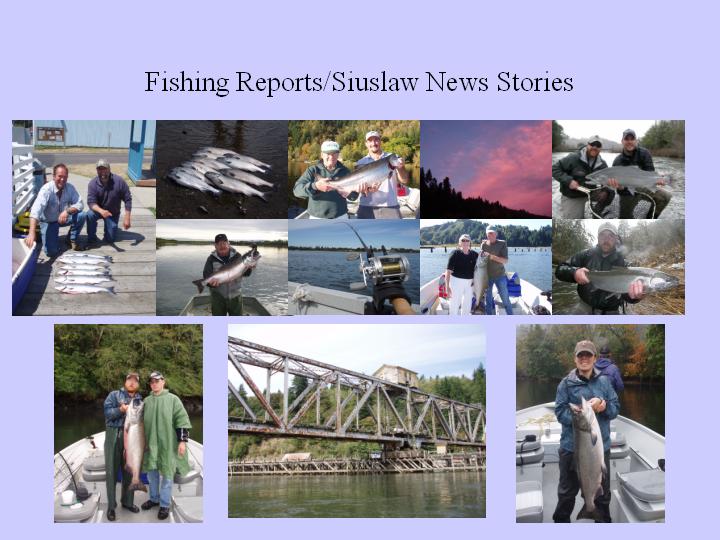
Friday, June 6, 2008

Run Timing – Then And Now

A few weeks ago, a fellow angler and I were talking about how the salmon and steelhead weren’t showing up the same time of year they used to. This friend told me, “You know, the steelhead fishing was really good around Thanksgiving, and the run was over by January.” That got me to thinking about when fish should be showing up. Were the runs years ago healthier than today?

When Do Fish Come Back?
Anadromous (sea run) fish return to their home river anywhere from months before they spawn to hours before they spawn. For instance, on the Columbia River, steelhead bound for rivers in Idaho (Columbia River tributaries) enter freshwater many months before they actually spawn. And on Oregon coastal rivers, salmon and steelhead may spawn just hours after entering freshwater. In other words, the length of the journey to spawning grounds dictates (in part) when fish enter a river. Anadromous fish, particularly fall chinook salmon, may also hold in lower stretches of coastal rivers until water levels raise enough to allow them to access suitable spawning gravel. An example of this is as follows: a fall fish may enter the river in September and slowly work its way upriver, and when freshets raise the water level in early November, the fish enters a tributary and spawns during the middle of November.

Run Timing – An Inexact Science
While it’s tough to predict when the “peak” of the run will be, research on salmonids gives us some clues as to when most of the fish will be in the river. On Oregon coastal rivers, run distribution is on a Bell Curve. When examining fall chinook salmon, this means that some fish will be present in the bay and river during July, and some fish will be present in January, but the peak of the run will be present some time during October or November. We make this assumption based on sport catch and results of spawning fish surveys. When we take a look at winter steelhead, the timing is different. Most of these fish spawn in the spring (March and April). And while some steelhead are in the rivers in November and some fish are in the river in May, the peak of the run will probably be in January and February. A Thankgiving peak run just doesn’t sound quite right to me, at least not on the Oregon coast.

What Affects Run Timing?
It’s not that my friend was wrong. I’m sure he had the dates right. But there are many things that can impact run timing of salmon and steelhead. Probably the biggest single impact on run timing in the past was poor hatchery practices. And this is how it works: the eggs of fish used by the hatchery were taken from the first fish that made it to the weir. So, over a few generations the hatchery, by just taking these early fish, inadvertently selected for early arriving fish. Today, hatchery practices are changing. Those in charge realize that fish should be selected throughout the run to ensure that fish come back during the entire time they would naturally.

See you on the water,
Action Jackson

(Please send comments or questions to Action Jackson at 268-6944 or www.actionjacksonfishing.com)

Wednesday, May 28, 2008

Ethanol And Your Boat

In the most recent Underway magazine (sponsored by the Oregon State Marine Board and U.S. Coast Guard), there were several interesting articles. One of the articles discussed ethanol blended fuel, better known as E-10. This is something that folks have asked me about, and now I’d like to share what the OSMB has to say about it.

First off, it will be mandatory for all gas stations statewide to start selling gasoline with 10% ethanol by Sept. 30, 2008. When this was first made public, many weren’t happy with the state’s decision – especially aircraft pilots and boaters. In response, legislators passed Senate Bill 1072, which allows retailers to sell unblended fuels for use in aircraft, ATVs, power tools and boats. Allowing unblended fuel to be sold came about when state officials learned that ethanol easily absorbs water, which contaminates fuel and causes engines to seize up. Also, since ethanol is a solvent, it can damage fiberglass fuel tanks, rubber and internal engine parts (especially in older boats).

State Marine Board officials feel that marinas are the most likely places to find unblended fuels, but that it may be difficult to find at gas stations. But there are things you can do to minimize any negative impacts.

· Make sure you know what fuel your retailer is dispensing.
· Run a non-alcohol fuel stabilizer in your boat’s fuel system at all times. This is definitely recommended for engines that sit for any length of time.
· The more use a boat gets, the less likely it is to have problems.
· When winterizing, keep your tank approx. 95% full to prevent condensation but allow room for expansion. Try to avoid any water intrusion.
· Install a water separating fuel filter.
· Change your fuel filter regularly.
· Replace older plastic tanks with new tanks.
· Replace older rubber fuel lines and inspect them regularly.
· Some older carbureted engines may require special tuning. Consult the manufacturer for details.

For more information about E-10, visit the OSMB website at http://www.boatoregon.com/OSMB/news/E10.shtml.

I’m going to run E-10. My boat gets a lot of use during the year and I already have a fuel-water separator in-line on my fuel system. Stay tuned for updates.


See you on the water,
Action Jackson

(Please send comments or questions to Action Jackson at 268-6944 or www.actionjacksonfishing.com)

Saturday, May 24, 2008

Summer Must Reads and Must Sees

I know how it is. Many of you out there are already thinking about salmon fishing here on the river and its not even Memorial Day. Well, if you’re thinking about it you might as well read about it, look at some different rigging techniques and watch an informative DVD so when the fish are here you can maximize your opportunities. Frank Amato Publications (www.amatobooks.com) is the leading publisher of salmon and steelhead books and DVDs. The list of materials offered by Amato Publications is very impressive. You are guaranteed to learn something new. Here are some of the latest offerings.

· Angling Techniques For River Kings (DVD). Featuring Nick Amato, Kris Olsen and a personal friend of mine, Rob Russell. The DVD discusses fish location and techniques such as plug fishing, back bouncing, drift fishing and float fishing.
· Basic Stream Flies: How To Choose, Fish & Tie Them (Book). Though there are always exceptions, you don’t need hundreds of different flies when trout fishing. In most situations you only need a few different patterns. This book contains 28 patterns that can be used to match many scenarios. Each pattern is accompanied with step-by-step instructions on tying it.
· How To Catch Salmon, Sturgeon, Lingcod, Rockfish and Halibut Along The Pacific Coast (Book). This book is packed with great information that is useful for fishing in saltwater anywhere from California to Alaska. Author Wayne Heinz discusses fish behavior and the best methods for catching all of the fish listed in the title. Other topics covered include finding credible fishing reports, maps and tide tables, and cooking your catch.
· Illustrated Rigging For Salmon Steelhead Trout (Book). Robert Campbell has put together a great book that includes numerous rigging techniques for any situation you would encounter. Campbell includes rigging for rivers, lakes, the ocean and small streams. If you like to catch salmonids, get this book.
· 300 Tips To More Steelhead & Salmon (Book). When it comes to writing, there may be no other as prolific or accomplished than Scott Haugen. His latest book offers literally hundreds of tips to help anglers make the most of their time on the water and catch more fish. There are many tips bank anglers as well. From beginning angler to 70-year veteran of the Siuslaw, there will be something in this book you will find useful.
· Side-Drifting For Steelhead (DVD). Take it from me: side-drifting under the right conditions can be deadly. It is one of the top methods for fishing steelhead. Topics covered in this 60 minute DVD include: boat handling and position, reading water, weight selection, bait and etiquette.

Check out these and many, many other titles from Amato Publications. Make the most out of your next trip on the water.


See you on the water,
Action Jackson

(Please send comments or questions to Action Jackson at 268-6944 or www.actionjacksonfishing.com)

Invited Out On A Friend’s Boat? Some Things To Keep In Mind

As we all know, many anglers are boat-less. Let’s face it: there are better investments out there. From storage and maintenance to a truck to pull the boat to state fees and the recent boating license, I can see why so many anglers choose not to have one. Just because you don’t have a boat doesn’t mean you can’t team up with a friend or neighbor who does have a boat. It’s a relationship that can be mutually beneficial. If you’re invited aboard a friend’s boat for the first time, it can be a little weird. Here’s a few things to keep in mind that will (hopefully) get you invited back for future trips.

Before/During The Trip
There are lots of arrangements to take care of ahead of time. Coordinate with the boat owner to make sure you know where you are meeting and at what time. DON’T BE LATE! The people I fish with know that I am always early and ready to go. Be the same way. Other things to consider:
Before the trip is a good time to make food arrangements. If you bring food, have enough to share with the other folks on the boat.
Make sure the boat owner has a PFD (life jacket) for you. If not, bring one. If the boat is stopped and ticketed for not having enough safety equipment, it will be the boat owner who pays.
Do not bring uninvited guests. This includes dogs. Clear it with the boat owner first.
Ask about what gear you need to bring and don’t bring other stuff. A boat cluttered with extra poles, tackle boxes and coolers is a hassle.
Offer to get the bait. Find out what kind, what size and ask where to get it. Find out if it needs to be thawed or frozen. Bring enough for everyone on board.
Be considerate with trash and dropped food/drink. Even though a boat owner might not admit it, we really hate to see potato chips and soda spilled everywhere.
Help with the launch and retrieval of the boat.
Last, and definitely not least, don’t dictate what time you have to be off the water. If you’re going out, assume its all day. It is really annoying to have someone on the boat who wants to get back to the dock by 5:00 so they can catch a movie. This is very poor etiquette. We understand that other things need to get done. But don’t accept the invitation unless you can stay out.

I Probably Don’t Need To “Chip In” (He Was Going Fishing Anyway)
There are many, many costs associated with owning and operating a boat. The price of fuel seems to be going up every day. There are launch and parking fees to be paid. Offer to pay your share or more. To feel that someone was “going anyway” and so you don’t need to chip in is a great way not to be invited back. The boat owner may or may not accept your money, but make sure to pitch in.

When I’m trolling the river in the fall, I see many boats with just one person aboard. With so many folks out there crazy about fishing, surely there’s someone out there to help split the cost of fuel and help you clean up afterward. There’s a lot of room in this topic for a future article, so feel free to drop me a line and let me know how you operate, boat owner and boat-less alike.

See you on the water,
Action Jackson

(Please send comments or questions to Action Jackson at 268-6944 or www.actionjacksonfishing.com)