Friday, October 16, 2009

Breaking Rods On Fish Is Fun!


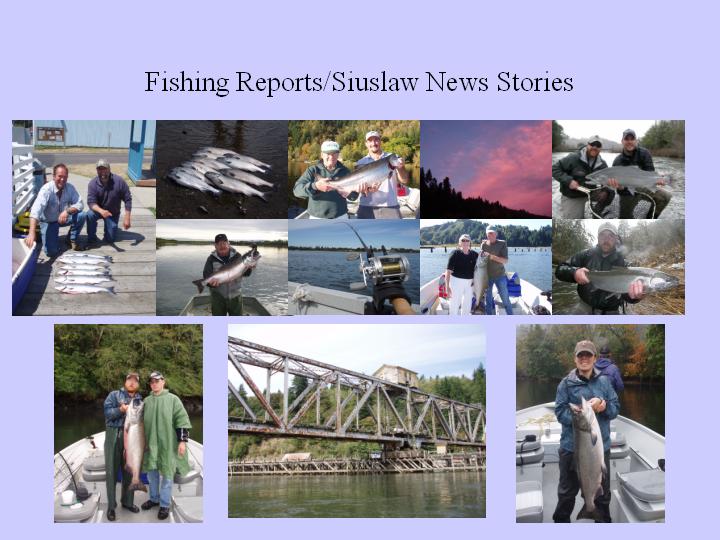
Fishing has been pretty good here on the Siuslaw. Expect good fishing this weekend (Oct. 17-18) unless high winds make controlling the boat difficult. A big thanks to Josh, Rick and Dave who were on my boat over the weekend. Who says breaking a rod sucks! We think its great!

Sunday, October 4, 2009

October Fishing Picking Up

Hello Readers
Sorry for the long delay in posting. The fishing has been picking up on the Siuslaw. Good numbers of chinook began showing in Mapleton over the weekend. Many of the fish were smaller 3 year-old fish ranging from 10-15 lbs. Look for pictures soon.

Thursday, August 6, 2009

Fishing License Fees Increasing in 2010

The Oregon Legislature recently approved large increases in fishing and hunting license fees for 2010 (and beyond). ODFW agency representatives are shining the best light possible on the fee hikes that sportsmen might have a tough time swallowing. Fee and tag increases are to help offset the increasing costs of managing fish and wildlife in Oregon, and also offer us the following:
· Habitat restoration projects to benefit deer and elk populations
· Increased trout stocking for lakes, ponds, reservoirs and rivers
· Two additional Oregon State Police Fish and Wildlife Division officers in Central Oregon
· A two-pole option: A new $17 validation will allow licensed anglers to fish with a second fishing pole and line on most lakes, ponds and reservoirs
· Fish passage and riparian and in-stream habitat enhancement programs
· Additional funding for commercial fishing law enforcement

And here’s what you really want to know – how much are fees and tags going up? Here’s a partial list. The whole list can be found on the ODFW website at http://www.dfw.state.or.us/agency/budget/. There’s a box on the right side of the page that will link you to the fee increases.
· Annual Resident Angler - $33.00 (was $24.75)
· Combined Angling Tag – $26.50 (was $21.50)
· Annual Resident Combo Hunting/Fishing - $58.00 (was $43.75)
· Annual Nonresident Angler - $106.25 (was $61.50)

The Resident Shellfish License is still a good deal at $7.00 (was $6.50) as is the Hatchery Harvest Tag at $16.50 (was $13.50).

There are definitely some things that caught my attention in the ODFW press release. First, increased trout stocking in local lakes will do little more than feed the cormorants unless stocking methods are changed. Hatchery planting should take place in the late evening or overnight. It will give fish a chance to disperse and maybe give us a chance to catch them. More stocked fish being delivered the same way won’t help. I am very willing for fee increases to go toward enforcement, especially in the ocean and on the Columbia River. Too many fishermen feel like its not against the law if nobody sees it. On the other side – fee increases really hurt the average guy who wants to introduce the family to the outdoors. Sometimes it feels like we’re moving toward how they fish in Great Britain: only the rich can afford to fish for salmon and trout. Everyone else is reduced to fishing for rough fish.


See You On The Water,
Action Jackson

(Please send comments or questions to Action Jackson at 268-6944 or www.actionjacksonfishing.com)

You Guides Make Too Much Money

It seems that people want to give me a piece of their minds all the time. Last week I was talking about my bookings for the upcoming fall salmon season when someone asked, “how much do you charge?” When I told them my rates, they proclaimed, “that’s too much.” At first, I was offended by this accusation. Obviously this person thinks what I charge per day is pure profit. Far from it! There are many costs associated with being in business for yourself – and its no different with guiding.

Having literally thousands of dollars tied up in boats and motors, a truck, rods and reels, tackle and lures, traps, nets, electronics, and safety equipment is only the start. I use all top-quality equipment – folks paying money for a fishing trip deserve to have gear that won’t fail on them in a critical moment. You won’t find any duct tape on any of my gear. I could go with lower-quality equipment, but I wouldn’t have as much confidence in it, and you wouldn’t have as much confidence in me.

There’s a whole other side of business costs too. Fuel, insurance (truck, boat, liability), bait, licenses, maintenance are just a few of my expenses. I can easily burn $50 worth of fuel in a day, and $50 worth of bait. Insurance is well over $100 per month. If something needs repaired on my truck or boat, a minimum expense is $250. To obtain my U.S. Coast Guard licenses, I traveled to Astoria and took classes, one 1-week class and one 2-week course. This doesn’t include state licenses or tags for my truck and trailer. I am also required to attend CPR/First Aid courses every year. And then there’s advertising: we traveled to a Sportsman’s Show in Idaho and I distribute brochures in the area.

Finally, my day doesn’t start when I meet folks at the dock and end when they get off the boat. If I meet folks at 6:00, I’m up and getting stuff ready by 4:00. Lunch needs to be made, coolers packed, load gear, double check to make sure all equipment is ready and secure. Pulling out of the driveway by 5:00. I try to get to the launch at least 30 minutes early to account for any crowds and because its inevitable that fishermen always get there early. I have to be ready to go. Fast-forward to the end of the day. We’ll fish for a minimum of 8 hours (unless we get early limits), many times fishing for 10 hours. I clean the fish and pull the boat out. I stop by the gas station and fuel up. Boat gets washed and motors flushed. All the rods get re-rigged and prepped for the next day. I brine and prepare the bait. Whoa, its 7:00 p.m.! Time to slam down dinner so I can make some phone calls before it gets too late. During the season, I can easily put in 14-16 hour days.

You get what you pay for. Many folks choose to come fishing with me a few times a year rather than buy their own boat because owning and maintaining a boat is a big expense. Way bigger than going with a guide a few times a year. My prices might seem high to some because they don’t realize all that goes into the guiding business. If guiding was the easy way to be a millionaire, there’d be a lot more people doing it.


See You On The Water,
Action Jackson

(Please send comments or questions to Action Jackson at 268-6944 or www.actionjacksonfishing.com)

Thursday, July 23, 2009

Dear ODFW: Please Remove Restrictions on Introduced Species

Last week I got into a conversation about smallmouth bass fishing on the Umpqua River. As some of you know, the bass fishing from (practically) Roseburg to Scottsburg can be amazing. You can catch fish all day, every day during the summer. You can literally catch 100+ bass a day. Anglers are recognizing the Umpqua River as one of the best smallmouth bass fishing locations in the world. The Big K Guest Ranch in Elkton is promoting this fishery as catch and release and demanding that anyone putting in on their property or passing through release these fish. Anyway, back to my conversation: this person wanted to know why there are daily limits on these fish. As it stands right now, the daily limit is 10 bass per day, any size. I, and many others feel this is too restrictive. Removing the limit on these fish, and other introduced fish in Oregon will help reduce their impact on our native salmon and trout.

Competition For Food And Space
A typical stretch of river only offers so much in the way of food and space for fish. There are only so many aquatic insects that can be eaten, only so many rocks and ledges for cover. When you increase the number of fish 10-fold, or 100-fold, some fish will lose out. Most often it’s the less-aggressive salmonids. Smallmouth bass are tough and aggressive feeders. So even though you might not find a salmon fry in the stomach of the next bass you catch, it doesn’t mean they aren’t competing with, and negatively impacting cold-water fish. If you still don’t think it’s that big of an impact, try inviting 100 people to your house to live for a few days. I think you’ll get the idea.

Striped Bass – Smolt Eating Machines
Striped bass, originally introduced to the Sacramento Delta from the East Coast in the late 1800’s, are well adapted to the Umpqua/Smith River systems. ODFW actually released these fish into certain Oregon rivers and bays for an additional sport fishing opportunity, not realizing that they are very efficient at feeding on juvenile salmon. Though striped bass populations go through peaks and valleys, there are still some large numbers of fish in the Umpqua, Coos Bay and the Coquille River.

ODFW, please consider these regulation changes:
REMOVE the daily bag limits on smallmouth bass and striped bass in the Umpqua/Smith system. The state of Oregon and federal government agencies spend millions each year on habitat restoration, dam removal, barging fish and other projects throughout the state to benefit salmon and trout. This simple step would cost nothing and benefit native fish greatly.

See You On The Water,
Action Jackson

(Please send comments or questions to Action Jackson at 268-6944 or www.actionjacksonfishing.com)

Keep Your Reels Running Smooth

This is usually the time of year I try to clean and maintain all my reels for the upcoming fishing season. It’s a good idea to clean and lubricate your reels at least once a year. It’s the same philosophy as with your car: don’t wait until something goes wrong to take action. The saying “an ounce of prevention is worth a pound of cure” was never more true. You don’t want your reel blowing up when you have a trophy fish on the line. There are things you can do at home, and other things you should leave to a professional. Let’s start with what you can do at home

Easy Maintenance
One thing that’s easy to do and should be performed every time you get back from fishing: wash your reels down with a mild soap and water. This is especially important if you’ve been fishing in saltwater. Hose the reels down, and take a couple of minutes to wash down your rods (especially the line guides). Saltwater can take a real toll on your gear. An old toothbrush is perfect for getting into tight spaces and removing sand, egg goo and dirt. Next, take time to lubricate your reels. A good three-in-one light penetrating oil or the reel oil that came in the box with your reel helps prevent rust and keeps moving parts working well. You can remove the reel cover and apply a couple of drops to the gears. Remember, just a couple of drops as the gear oil goes a long way. Also, tighten any screws that hold your reel cover together. Check these screws every time you go out. It only take a second and can lead to a major disaster if the reel comes apart while playing a fish. Don’t ask me how I know this. Finally, make sure to check that your reel is seated properly on the rod and that it is tightly fixed to the rod.

You’d Better Take It To The Shop
There are some reel problems that should be handled by experts. If you have a lot of sand and dirt in your reel, or its badly rusted, you are probably better off having a pro take a look. Also, even high-priced reels have plastic washers that wear out, and it’s best to have an expert replace them. If the line guide moves independently of the handle, or doesn’t move at all, take it to the shop.

Where To Go For Professional Help
Here’s a couple of places to go if your have a “reel” emergency:

2 Bro’s Tackle, 900 McKinley St., Eugene, (541) 434-1133, 2brostackle@gmail.com

Ollie Damon’s, 236 SE Grand, Portland, (503) 232-3193, www.olliedamons.com

See You On The Water,
Action Jackson

(Please send comments or questions to Action Jackson at 268-6944 or www.actionjacksonfishing.com)

Thursday, July 9, 2009

Keep a Boat Log

When was the last time you changed your outboard oil? What about the gear lube? What was the water temperature on Sept. 16, 2004 and did you catch anything? These questions and many others can be answered by keeping a boat log book. Though its probably one of the last things you’ll consider after spending a day on the water, a log book can be invaluable when it comes to properly maintaining your boat and can help you catch more fish.

Where Do I Start?
Start by keeping a small notebook and pencil in a sealable plastic bag in your boat. Across the top of the page is a good place to put some general headings: Date, Time, Location, and Notes. Whenever you perform some sort of upkeep or maintenance to your boat, write down what you did and any other notes (i.e., oil was off color, etc.). That way, you can compare notes from the last time and perhaps head off a major engine problem.

Details, Details
After a day on the water, take a couple of minutes and update your log book. While you can write down as much or as little as you want, you should record things such as how long your motors ran (crucial for maintenance), where you launched, water temperatures, tide information, who was with you and what you caught. Generally, the more you write down the better off you’ll be. After a few trips worth of log book entries, you can begin to establish patterns: whether or not you caught more fish on the incoming tide, if you’ve had better success in 48 degree water or 58 degree water, and who never chips in for gas money. As far as maintenance, record changes for oil, gear lube, batteries, spark plugs and filters. Write down anything unusual, such as electronics that didn’t work properly. There are many facts about your fishing trip you can log, including

Using The Information
With a well-kept log book, you can make the most of your fishing trips. You can review the log book and concentrate on fishing those dates (and tides) that are most like the dates and tides where you’ve succeeded in the past.

See you on the water,
Action Jackson

(Please send comments or questions to Action Jackson at 268-6944 or www.actionjacksonfishing.com)